What Is a Cajon? Origins, Anatomy, Sounds and Types
A cajon is a box-shaped percussion instrument from Peru that you sit on and play with your hands. See how it's built, how it sounds and its main types.
Ökecajon Workshop20 min read
In this article
- What is a cajon used for?
- How do you pronounce cajón?
- Where does the cajon come from? A short history
- How was the cajon born in Peru?
- How did the cajon get into flamenco?
- How was the cajon officially recognized?
- What are the parts of a cajon?
- What is inside a cajon?
- Peruvian vs. flamenco cajon: what's the difference?
- How does a cajon make sound?
- Is a cajon a drum? Idiophone vs. membranophone
- What are the main types of cajon?
- Snare and string cajons
- Bass cajon
- Tablet, wearable and belly cajons
- Bongo cajon and cajonga
- Kids' cajons
- Latin American relatives
- Where should a beginner start?
- Frequently asked questions
- Sources
Born among Afro-Peruvian communities on Peru's coast, the cajon crossed into flamenco in the late 1970s and from there onto pop, rock and acoustic stages around the world. Today you'll find everything from the plain, wire-free Peruvian box to snare, bass, tablet and bongo cajons. If you want to start playing right away, see our guide on how to play cajon; if you're shopping, start with how to choose a cajon.
What is a cajon used for?#
A cajon does the job of a drum kit's bass drum and snare in a single wooden box, and since you sit on it, it doubles as your seat. According to Wikipedia, bands often use a cajon instead of a full kit in stripped-down settings because it serves as both the bass drum and the drummer's seat (Wikipedia). For gigs where a full drum set is simply too much, there are also bass cajons built for a deeper low end (Meinl).
You'll hear the cajon in:
- Afro-Peruvian music: The tradition it was born in. The cajon has been the most widely used Afro-Peruvian instrument since the late 19th century, and it drives coastal styles such as festejo, tondero, zamacueca and the Peruvian waltz.
- Flamenco: It reached Spain with Paco de Lucía's band in the late 1970s and spread quickly through flamenco.
- Pop, rock, blues, jazz and funk: Especially as the rhythm section behind a solo acoustic guitar or piano.
- Cuban rumba and Irish folk: It's played in some modern Cuban rumba styles and has become a popular instrument in Irish folk music.
Most players use their bare hands, but brushes, mallets and sticks work too, and some percussionists attach a bass drum pedal so they can play it with a foot (Wikipedia). For the core patterns behind these styles, see our guide to cajon rhythms.
How do you pronounce cajón?#
Say "kah-HOHN," with the stress on the second syllable (IPA: kaˈxon) (Wikipedia). The Spanish j is a breathy, throaty h, close to the "ch" in Scottish "loch," so "ka-JON" with an English j isn't quite right.
In Spanish, cajón means "box," "crate" or "drawer." In English it's usually written without the accent, and it's often called a box drum. The Spanish plural is cajones, and a cajon player is a cajonero (Spanish Wikipedia).
Where does the cajon come from? A short history#
The cajon comes from Peru. It emerged among Afro-Peruvian communities on the Peruvian coast during the colonial era and slavery, reached Spain through flamenco in the late 1970s, and spread worldwide from there. Peru declared it part of its national cultural heritage in 2001.
| Date | Event |
|---|---|
| Colonial era and slavery | Afro-Peruvian communities on Peru's coast turn wooden crates into instruments. |
| Around 1850 | The first written references to the cajon as a musical instrument appear in Lima. |
| Late 19th century | The cajon becomes the most widely used Afro-Peruvian instrument. |
| Early 20th century | Today's upright box shape replaces the horizontal cajon. |
| Late 1970s (usually given as 1977) | Paco de Lucía discovers the cajon in Lima, and it enters flamenco. |
| August 2, 2001 | Peru's National Institute of Culture (INC) declares the "Cajón Peruano" National Cultural Heritage. |
| November 1, 2014 | The Organization of American States (OAS) names the cajon "Instrument of Peru for the Americas." |
| November 15, 2017 | Peru's Congress approves Law 30716, making August 2 Peruvian Cajon Day. |
How was the cajon born in Peru?#
The cajon was created by enslaved Africans and their descendants in colonial Peru. Wikipedia describes two complementary origin theories. One holds that it descends directly from box-shaped instruments of West and Central Africa, especially Angola, which enslaved people recreated from the Spanish shipping crates they had at hand. The other holds that crates were used to get around colonial bans on music in predominantly African areas, essentially disguising the instruments (Wikipedia). Spanish Wikipedia adds that the Catholic Church banned drums as "pagan" and that any drum found was burned.
The first references to the cajon as a musical instrument in Lima date from around 1850 (Spanish Wikipedia). By the end of the 19th century it was the most widely used Afro-Peruvian instrument. In the early 20th century, the upright box we know today replaced the horizontal cajon, and Porfirio Vásquez, known as the patriarch of Afro-Peruvian music, standardized that form.
Other celebrated masters include Francisco Monserrate, Víctor Arciniegas, Caitro Soto (Chabuca Granda's cajonero) and Ronaldo Campos, director of the ensemble Perú Negro (Spanish Wikipedia). According to Wikipedia, under the influence of Perú Negro, founded in 1969, the cajon became more important than the guitar in festejo and "a new symbol of Peruvian blackness."
How did the cajon get into flamenco?#
The cajon's journey abroad began with Spanish guitarist Paco de Lucía's Latin American tour in the late 1970s (usually given as 1977). As Peru's El Comercio tells it, the Spanish ambassador to Peru threw a party in his honor in Lima, where Chabuca Granda sang "La flor de la canela" with Caitro Soto on cajon. Paco de Lucía bought Soto's cajon for 12,000 pesetas and gave it to his band's percussionist, Rubem Dantas (El Comercio).
According to Spanish Wikipedia, Paco de Lucía felt the cajon sounded like the sole-and-heel strikes of a flamenco dancer's footwork, which made it a natural fit for his music. Other flamenco percussionists followed the Brazilian Dantas, and the instrument spread quickly across Spain. There it became known as the "cajón flamenco," a name that stirred controversy in Peru because it suggests a Spanish origin (Spanish Wikipedia).
How was the cajon officially recognized?#
On August 2, 2001, Peru's National Institute of Culture (INC) declared the "Cajón Peruano" part of the nation's cultural heritage (Patrimonio Cultural de la Nación) (Wikipedia). On November 1, 2014, the Organization of American States (OAS) named it the "Instrument of Peru for the Americas" (Instrumento del Perú para las Américas) at a ceremony at its headquarters in Washington, D.C. The same ceremony posthumously honored Rafael Santa Cruz (1960–2014), author of "El cajón afroperuano" and the first researcher to document the cajon's origins in Peru comprehensively (Peru's Ministry of Culture).
August 2 is now Peruvian Cajon Day (Día del Cajón Peruano). Law 30716, which established it, was approved by Peru's Congress on November 15, 2017. The original proposal called for October 23, the anniversary of Caitro Soto's death; the Ministry of Culture proposed August 2, the same date as the 2001 heritage declaration (Spanish Wikipedia).
What are the parts of a cajon?#
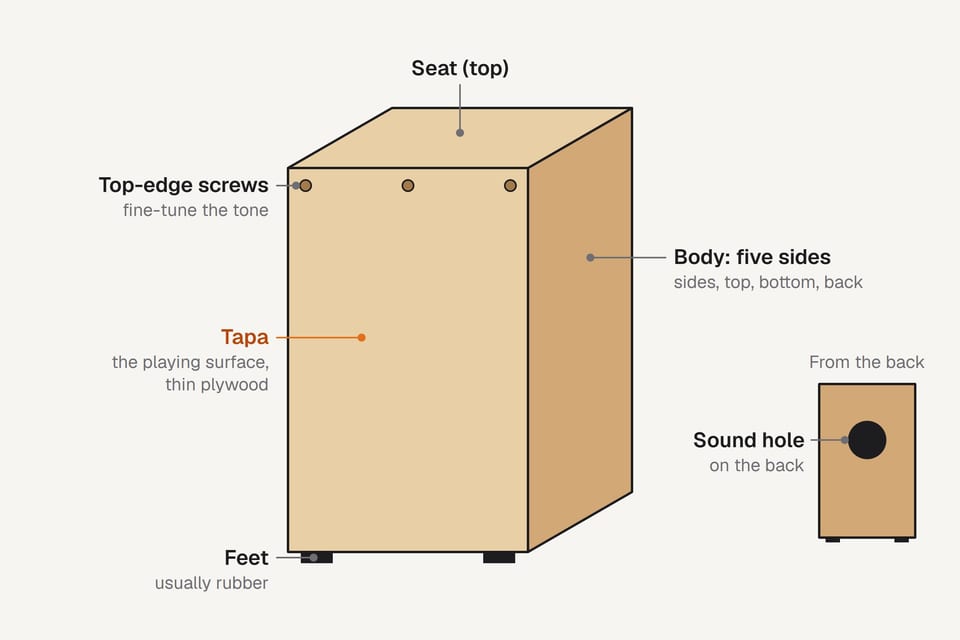
A cajon is a six-sided wooden box: five sides form the body, and the thinner sixth side, the tapa, is the playing surface. A sound hole is cut in the back, and modern cajons have screws along the top edge for adjusting the tone and may have rubber feet underneath (Wikipedia).
| Part | What it does | Typical build |
|---|---|---|
| Tapa (front) | The playing surface; produces the bass and slap tones | Thin plywood, often birch or maple |
| Body | Five resonating sides; also the seat | Typically 1/2 to 3/4 in (13–19 mm) wood; 3/8 to 1/2 in (9–12 mm) birch plywood bodies also exist |
| Sound hole | The air inside is pushed out here when you strike the tapa | In the back panel |
| Top-edge screws | Hold the top of the tapa to the body and fine-tune the tone | The number varies by model |
| Wires | Buzz against the tapa for a snare-like sound | Only on snare and string cajons: guitar-type strings or snare wires |
| Feet | Where the cajon meets the floor | Usually rubber on modern cajons |
The tapa does the job a drumhead does on a drum, but it's a thin sheet of plywood, often birch or maple, rather than a stretched membrane. According to Kopf, a thinner tapa responds more quickly to a light touch and sounds brighter, while a thicker one gives a deeper, more resonant tone (Kopf Percussion).
The body panels are generally 1/2 to 3/4 inch (13–19 mm) thick, according to Wikipedia. Thinner birch plywood bodies are also used today: Meinl's Woodcraft series has a 3/8-inch (9 mm) Baltic birch body, and its professional versions a 1/2-inch (12 mm) one (Meinl). In Peru, cajons were traditionally built from tornillo, cedar or mahogany, and later from moena and requia. Spanish Wikipedia gives typical dimensions of about 19–20 in (48–50 cm) tall and 12–14 in (30–35 cm) wide and deep.
The top-edge screws vary in number. Spanish Wikipedia describes three on a modern cajon, while Schlagwerk cajons have five along the top edge of the tapa. Schlagwerk says these screws can fine-tune the sound but recommends keeping the factory setting as far as possible (Schlagwerk). In the Peruvian tradition, players are also said to have pulled the nail from one of the top corners to get a different sound. Adjusting the screws and wires is covered in our guide to cajon care and tuning.
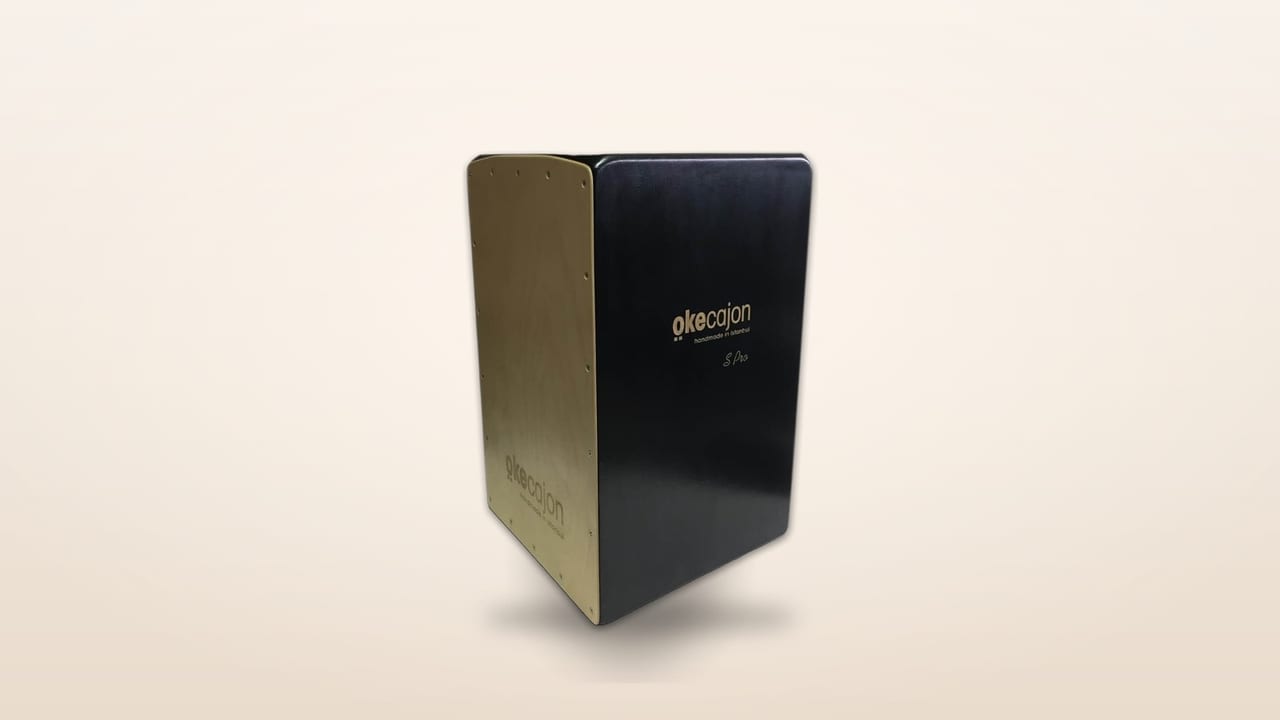
Ökecajon's Cajon S-Pro (CSP-S), handmade in Istanbul, is a current example of this design. It's a plywood cajon with a 3/8-inch (9 mm) birch body, a 1/8-inch (3 mm) birch tapa, 20×2 snare wires and four feet made from Ökecajon practice pad rubber. It measures about 11.4 x 11.8 x 19.7 in (29 x 30 x 50 cm) and weighs about 10.7 lb (4,850 g).
 ÖkecajonCajon S-ProCajon S-Pro₺100View
What is inside a cajon?#
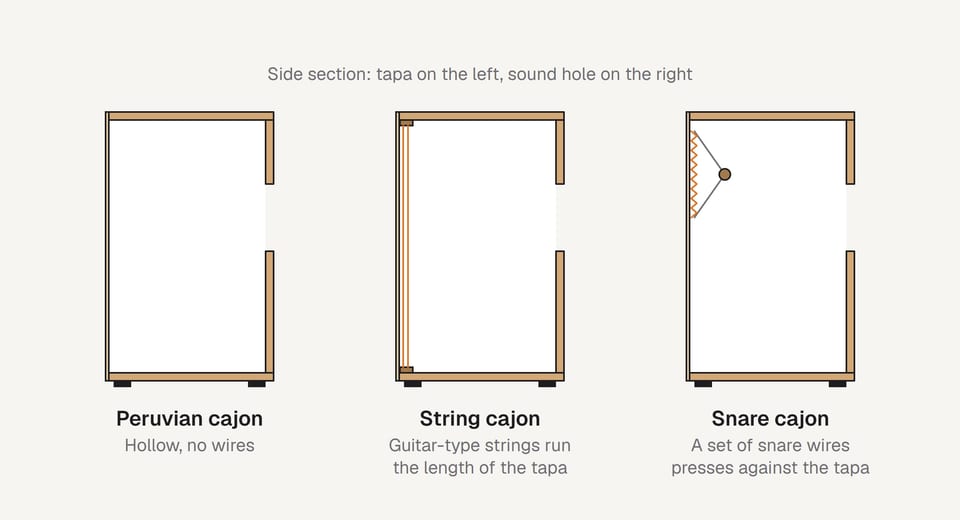
A traditional Peruvian cajon is empty inside. Flamenco-style cajons have guitar strings or snare wires mounted behind the tapa so that they touch its inner face; every stroke makes them buzz, adding a crisp sound that recalls the snare on a drum kit (Cajonbox).
Snare wires are the set of thin, coiled metal strands stretched across the bottom head of a snare drum, and snare cajons use the same kind of set behind the tapa. You'll find three basic designs:
- No wires (Peruvian): Nothing inside; all the sound comes from the tapa and the body.
- String cajon: Thin, coiled steel strings run the full length of the tapa, from top to bottom (Meinl). According to Cajonbox, flamenco cajons first used guitar strings, which were later replaced by snare wires. Spanish Wikipedia notes that in Spain three or four metal strings are typically fitted inside.
- Snare cajon: A set of snare wires, the same type used on a snare drum, sits behind the tapa. On Meinl's standard models the wires are fixed; on its Snarecraft Professional models they can be adjusted and thrown off with a foot pedal or a knob.
All three models in Ökecajon's cajon category have snare wires: 20×2 on the Cajon S-Pro and Bass Cajon S-Pro, and 40×2 on the Cajon Dedee. The catalog describes the Dedee, with its 5/8-inch (15 mm) laminated walnut and ayous body and 1/8-inch (3 mm) meranti tapa, as having a sharp snare sound.
Peruvian vs. flamenco cajon: what's the difference?#
The key difference is inside: a Peruvian cajon has no wires, while a flamenco cajon has strings or snare wires behind the tapa. According to Spanish Wikipedia, the name "cajón flamenco" came from the wires added in Spain and from changes in how the tapa is attached to the body.
| Peruvian cajon | Flamenco cajon | |
|---|---|---|
| Inside | Nothing; a plain box | Guitar strings or snare wires behind the tapa |
| Sound | Bass and slap with no buzz | A snare-like buzz added to the slap |
| Tradition | Afro-Peruvian music | Flamenco |
| Where the name comes from | Its Peruvian origin | Wires added in Spain and a different way of fixing the tapa |
The idea of adding wires actually predates the cajon's arrival in Spain. In the 1950s, players in Trujillo and Chiclayo in northern Peru fitted wires inside to brighten the high end, but the change never caught on because some cajoneros considered it "cheating." Peruvian singer Susana Baca has likewise stressed that Afro-Peruvian music does not use the "flamenco cajon" (Spanish Wikipedia).
How does a cajon make sound?#
A cajon has two basic tones: strike the center of the tapa for a deep bass, and near the top edge for a sharp, high slap (Kopf Percussion). The slap, played with the fingers near the top of the tapa, is the cajon's answer to the snare hit on a drum kit.
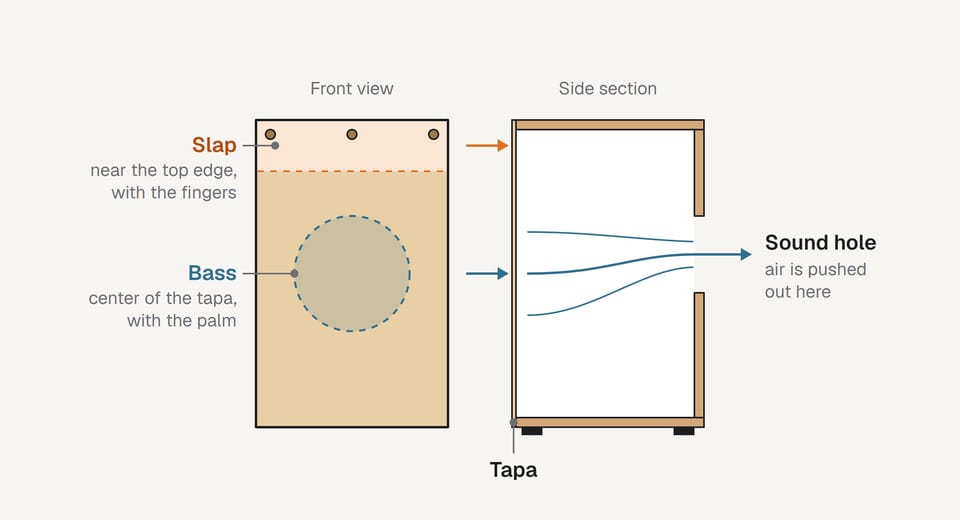
The bass comes from the tapa flexing inward and pushing on the air inside the body. As Kopf explains, the air is forced out of the sound hole, creating the pressure waves we hear as sound, and the size and placement of the hole affect the pitch and volume. This behavior, an enclosed volume of air breathing through a single opening, resembles the general acoustic principle known as Helmholtz resonance. Bass cajons are designed to amplify the effect: Meinl's use an internal bass reflex system and large, forward-facing ports that project the low end toward the audience (Meinl).
The slap is played near the edges, where higher frequencies come through. On a snare or string cajon the wires add their buzz, while on a wire-free Peruvian cajon the slap is pure wood. Spanish Wikipedia notes that Peruvian cajoneros draw different sounds from the corners, the center and the top edge. The side panels can also be played with the palms and fingers for extra sounds (Wikipedia).
| Tone | Where to strike | What it sounds like |
|---|---|---|
| Bass | Center of the tapa, with the palm | Low and full; the air exits through the sound hole |
| Slap | Near the top edge, with the fingers | High and sharp; buzzy on snare and string cajons |
| Side strokes | The side panels | Extra tones, distinct from the tapa |
Is a cajon a drum? Idiophone vs. membranophone#
In everyday speech, yes: it's a percussion instrument often called a box drum. Technically, though, it's an idiophone in the Hornbostel–Sachs system, which classifies instruments by what vibrates to make the sound. The cajon's sound comes from its struck wooden body, not a stretched membrane; its classification number is 111.24, in the group "percussion vessels" (Wikipedia).
An idiophone produces sound from the vibration of the instrument's own body. A membranophone produces it from a stretched membrane, whether a skin or a synthetic head. So while "box drum" is a common and useful name, a cajon isn't a drum in the strict, membranophone sense.
| Idiophone | Membranophone | |
|---|---|---|
| Sound source | The instrument's own body | A stretched membrane (skin or synthetic) |
| Examples | Cajon, shaker, woodblock, castanets | Bongos, congas, darbuka, snare drum |
A cajon also has no definite pitch; Wikipedia lists it among unpitched percussion instruments. So when players talk about "tuning" a cajon, they mean adjusting its tone with the screws and wires, not tuning it to a note. For other instruments in the family, see our guide to hand percussion instruments.
What are the main types of cajon?#
There are three main types: the wire-free Peruvian cajon, the snare or string (flamenco) cajon, and the bass cajon. Beyond those are tablet cajons played on the lap or a stand, wearable models carried on a strap, and hybrids such as the bongo cajon and the cajonga.
| Type | How you play it | Defining feature | Ökecajon example |
|---|---|---|---|
| Peruvian cajon | Seated on top | Hollow, no wires | None |
| Snare or string cajon | Seated on top | Wires behind the tapa | Cajon S-Pro, Cajon Dedee |
| Bass cajon | Seated on top | Designed for deeper bass | Bass Cajon S-Pro |
| Kids' cajon | Seated on top | Smaller body | Minish Cajon |
| Tablet (lap) cajon | On the lap or a snare stand | Flat, thin body | Tablet Cajon |
| Wearable cajon | On a guitar strap or a snare stand | Carried on a strap | Wearable Cajon, Belly Cajon |
| Bongo cajon | Between the legs | Two playing surfaces, like bongos | Octagonal Bongo Cajon |
| Cajonga | By hand, with brushes or mallets | A cajon-conga hybrid | Cajonga |
Snare and string cajons#
On a snare or string cajon, the wires behind the tapa add a snare-like buzz to the slap. The two are named for the wire type: string cajons use guitar-type strings, snare cajons use snare wires. Ökecajon's Cajon S-Pro and Cajon Dedee both have snare wires and rounded edges for playing comfort, and both come with a carry bag and a seat cushion.
Bass cajon#
A bass cajon is a box cajon designed for a deeper low end; Meinl recommends one for gigs where a full drum set is simply too much (Meinl). Ökecajon's Bass Cajon S-Pro (BC) has a 3/8-inch (9 mm) birch body, a 1/8-inch (3 mm) meranti tapa and 20×2 snare wires. It measures about 14.2 x 11.8 x 19.7 in (36 x 30 x 50 cm), versus about 11.4 x 11.8 x 19.7 in (29 x 30 x 50 cm) for the Cajon S-Pro.
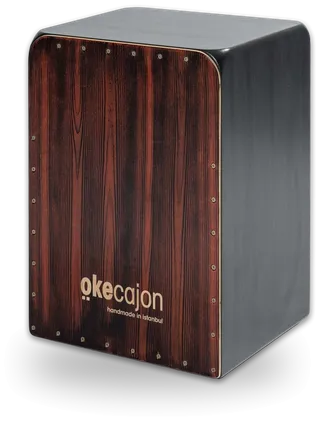 ÖkecajonBass Cajon S-ProBass Cajon S-Pro₺100View
Tablet, wearable and belly cajons#
Lap cajons are smaller and more portable than box cajons, according to Wikipedia. Ökecajon's Tablet Cajon (TC-BR) measures about 13 x 11.8 x 1.6 in (33 x 30 x 4 cm) and weighs about 1.8 lb (800 g). Both faces are playable, one with a natural bass tone and the other with a snare-like sound from its snare wires, and it fits on a snare stand (stand not included).
The Wearable Cajon (SNCW) takes any guitar strap on the pins at its sides; it measures about 13 x 11.8 x 3.9 in (33 x 30 x 10 cm) and weighs about 3.7 lb (1,700 g). The round Belly Cajon (BSC), about 10.2 in (26 cm) across and weighing about 1 lb (450 g), also works on a strap or a snare stand. We compare these models in detail in our guide to portable cajons.
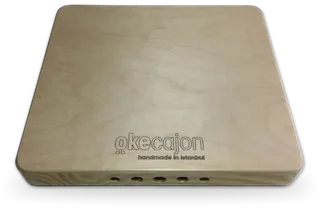 ÖkecajonTablet CajonTablet Cajon₺100View
Bongo cajon and cajonga#
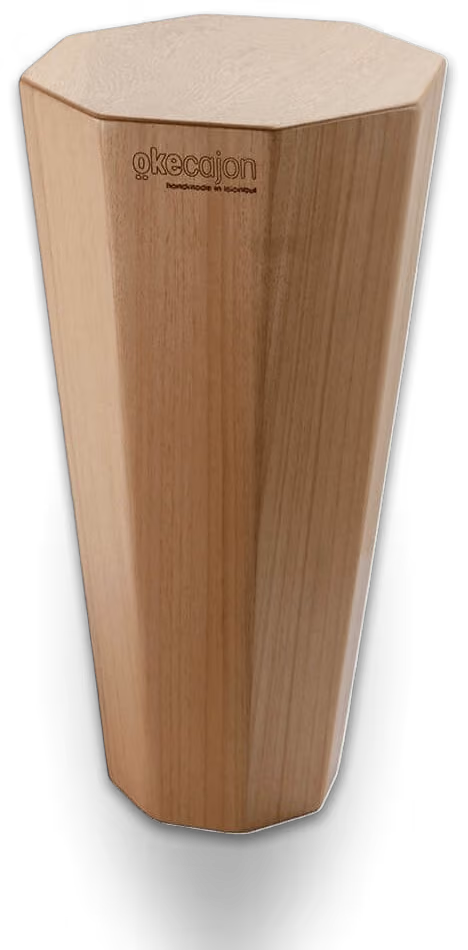
A bongo cajon combines the two playing surfaces of a pair of bongos with cajon construction. Ökecajon's Octagonal Bongo Cajon (OCB) is played with hand and finger techniques like regular bongos, and its octagonal shape sits comfortably between the legs. In a pair of bongos, the larger drum is called the hembra and the smaller the macho; on this model the hembra side measures about 8.5 in (21.5 cm) and the macho side about 7.5 in (19 cm). It's double-sided: one side gives a natural tone, the other a buzzy one from its snare wires.
The cajonga combines a cajon with a conga. Ökecajon's Cajonga stands about 19.3 in (49 cm) tall, measures about 9.8 in (25 cm) in diameter and has a 3/4-inch (18 mm) ayous body. It has a powerful bass and works with brushes and mallets; you can even play it like a darbuka, the goblet drum common in Turkey and the Middle East.
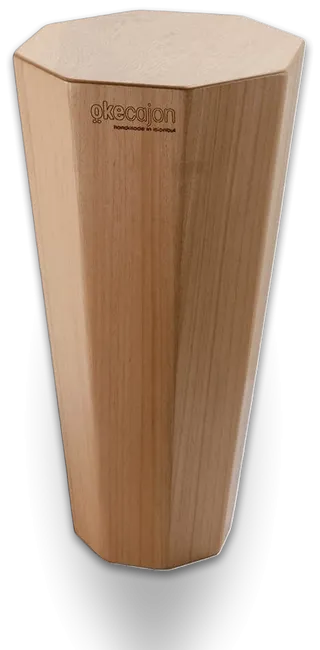 ÖkecajonCajongaCajonga₺100View
Kids' cajons#
Scaled-down cajons are made for children. Ökecajon's Minish Cajon (MSH), designed for young percussionists, measures about 8.7 x 9.1 x 12.6 in (22 x 23 x 32 cm) and weighs about 5.2 lb (2,350 g), with a 3/8-inch (9 mm) birch body, a 1/8-inch (3 mm) birch tapa and 20×1 snare wires. For help picking the right size for the player, see our guide on how to choose a cajon.
Latin American relatives#
The name cajón is also used for other box drums in Latin America, such as the Cuban cajón de rumba and the Mexican cajón de tapeo. In Cuban port cities like Matanzas, codfish shipping crates and small dresser drawers became similar instruments (Wikipedia).
Where should a beginner start?#
Start by choosing the type of cajon that suits where and how you'll play, then learn the posture and the two basic tones, and build your first grooves on top of them. Here's a practical order to follow:
- Choose a type. Decide whether you want a box cajon you sit on or a lighter model for your lap or a strap. Our guide to how to choose a cajon covers size, wood and wire systems, and our portable cajons guide compares the travel-friendly options.
- Learn the posture and the two basic tones. On a standard box cajon, you sit astride the box, tilt it slightly and strike the tapa between your knees (Wikipedia). Our step-by-step guide to how to play cajon covers posture, bass and slap.
- Play your first grooves. Once your bass and slap sound clearly different, move on to the basic patterns in cajon rhythms.
- Get to know your cajon. Read about the tapa screws, snare adjustment, cleaning and storage in cajon care and tuning.
- Expand your percussion. Small instruments such as a shaker can enrich your cajon grooves; see hand percussion instruments.
Browse Ökecajon's handmade box cajons in the cajon category, and the tablet, wearable and bongo cajons and the cajonga in the percussion category.
Frequently asked questions
What does cajón mean?
Cajón is Spanish for "box," "crate" or "drawer," a nod to the wooden crates the instrument grew out of. In English it's usually written without the accent and is often called a box drum.
How do you pronounce cajon?
Say "kah-HOHN," stressing the second syllable. The Spanish j is a breathy, throaty h, similar to the "ch" in Scottish "loch," so it isn't pronounced like an English j.
Where does the cajon come from?
Peru. The cajon emerged among Afro-Peruvian communities on the Peruvian coast during the colonial era, and the first references to it in Lima date from around 1850. It reached Spain through flamenco in the late 1970s, which is why it's sometimes called a flamenco cajon, and Peru declared it national cultural heritage in 2001.
Is a cajon a drum?
It's a percussion instrument that's often called a box drum, but technically it's an idiophone rather than a drum. Its sound comes from the vibrating wooden body, not a stretched membrane, and its Hornbostel–Sachs number is 111.24.
What is inside a cajon?
A traditional Peruvian cajon is empty. Snare and string cajons have guitar-type strings or snare wires behind the tapa that buzz against it for a snare-like sound. On some brands' professional models, the wires can be switched off with a pedal or a knob.
Do you sit on a cajon to play it?
Yes. With a standard box cajon, you sit astride the box, tilt it slightly and strike the tapa between your knees. Portable models such as tablet and wearable cajons are played on the lap, on a strap or on a snare stand.
Is the cajon hard to learn?
Getting started is approachable because you need just two tones: the bass in the center of the tapa and the slap near the top edge. The first goal is to make those two sound clearly different, then to play a simple 4/4 groove at a steady tempo; you don't need to read music to do it. Our how-to-play guide walks you through posture and your first grooves.
Sources#
- Cajón — Wikipedia
- Cajón (percusión) — Wikipedia, la enciclopedia libre
- Día del Cajón Peruano — Wikipedia, la enciclopedia libre
- Cajón Peruano es declarado 'Instrumento del Perú para las Américas' por la OEA — Ministerio de Cultura del Perú
- Paco de Lucía y la noche que se llevó el cajón peruano a España — El Comercio
- Understanding the Anatomy and Physics of Cajon Drums — Kopf Percussion
- Woodcraft and Snarecraft Cajons — Meinl Percussion
- Bass Cajons — Meinl Percussion
- Flamenco or Peruvian cajon? — Cajonbox
- FAQ – Frequently Asked Questions — Schlagwerk
Instruments in this article
Shop Cajon →




More from the Academy
Rhythm Academy →
Cajon
How to Play Cajon: Posture, Basic Strokes and Your First Groove
Learn cajon step by step: how to sit, where to hit for bass and slap, tones and ghost notes, your first 4/4 groove and a 30-day practice plan.
17 min read
Cajon
How to Choose a Cajon: Size Chart, Wood, Snares and Skill Level
How to choose a cajon: a size chart for adults and kids, how wood and the tapa shape the sound, snare vs string cajons, bass cajons and a buyer's checklist.
17 min read
Practice Pad
What Is a Practice Pad? What It's For and How to Use One
A practice pad is a quiet surface drummers use to build stick control and warm up. Learn what it does, how to set it up and use it, and what it can't do.
16 min read