How to Choose a Cajon: Size Chart, Wood, Snares and Skill Level
How to choose a cajon: a size chart for adults and kids, how wood and the tapa shape the sound, snare vs string cajons, bass cajons and a buyer's checklist.
Ökecajon Workshop17 min read
In this article
- 7 things to check before you buy a cajon
- What size cajon should I get? Size chart (inches and cm)
- A quick fit test
- How do wood and the tapa affect the sound?
- Snares, strings or none? Cajon snare systems explained
- Snare wire counts on our product pages
- Snare cajon vs string cajon
- What is a bass cajon, and who needs one?
- Which cajon for beginner, intermediate and pro players?
- What size cajon is right for kids?
- Choosing a cajon for home, stage, studio or travel
- What to look for in a handmade cajon
- Buyer's checklist
- Frequently asked questions
- Sources
A cajon is a box-shaped percussion instrument that you sit on and play with your hands. We cover its origins and anatomy in our guide What is a cajon?, so this one focuses on choosing. The examples below come from our own cajons, handmade in Istanbul. Dimensions are the approximate figures from our product pages, and the sources for everything else are linked in the text and listed at the end.
7 things to check before you buy a cajon#
Check the size, the type of sound, the tapa, the body, the snare system, the build quality and where you'll play. Size comes first: a cajon that doesn't fit you won't be comfortable to play, however good it sounds.
- Size: Your feet rest flat on the floor and your hands reach the top edge of the tapa without leaning forward.
- Sound: Without snares, with guitar strings or with snare wires; a standard or a bass cajon.
- Tapa: The wood and thickness of the playing surface, and how it's attached to the body.
- Body: Wood species, thickness and internal volume.
- Snare system: Fixed, adjustable or switchable?
- Build quality: Joints, screws, edges and non-slip feet.
- Where you'll play and what's included: Weight, gig bag and seat pad; home, stage or on the road?
What size cajon should I get? Size chart (inches and cm)#
For adults, the standard size is about 19–20 in (48–50 cm) tall. Spanish-language Wikipedia gives a typical cajon as roughly 48–50 cm (19–20 in) tall and 30–35 cm (12–14 in) wide and deep (Wikipedia, Spanish). That can be too tall for young children, which is why shorter kids' models exist.
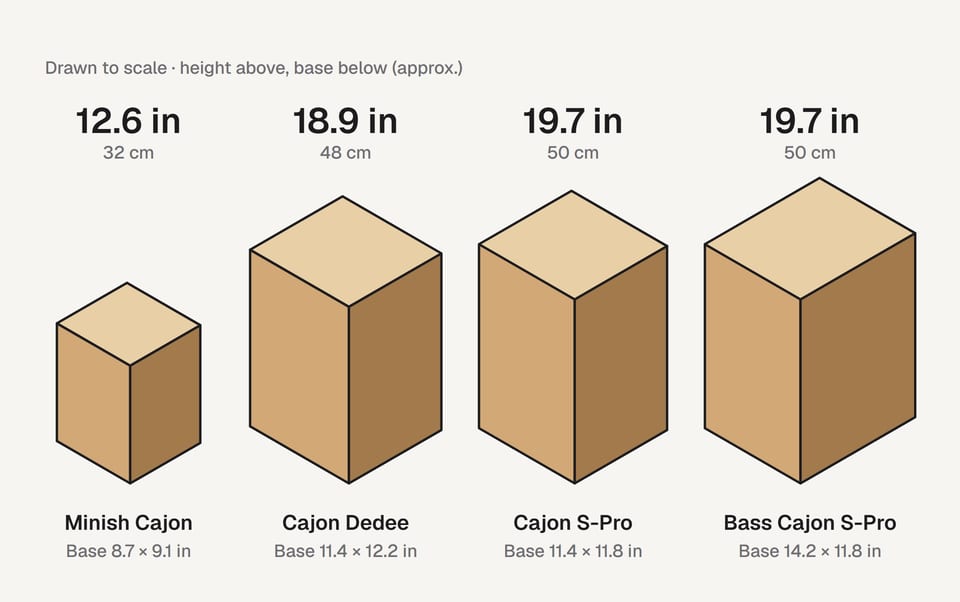
Here's how our cajons compare (approximate outer dimensions from our product pages; the last number is the height):
| Model | Size | Body | Tapa | Snare wires | Product page notes |
|---|---|---|---|---|---|
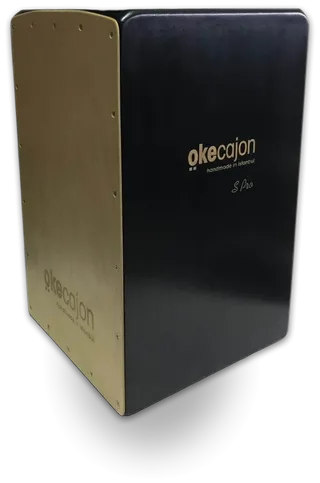
| Cajon S-Pro | 11.4 × 11.8 × 19.7 in (29 × 30 × 50 cm) | 9 mm birch | 3 mm birch | 20×2 | Designed for professional percussionists; studio and stage |
| Cajon Dedee | 11.4 × 12.2 × 18.9 in (29 × 31 × 48 cm) | 15 mm laminated walnut and ayous | 3 mm meranti | 40×2 | Sharp snare sound; studio and stage |
| Bass Cajon S-Pro | 14.2 × 11.8 × 19.7 in (36 × 30 × 50 cm) | 9 mm birch | 3 mm meranti | 20×2 | Studio and live settings |
| Minish Cajon | 8.7 × 9.1 × 12.6 in (22 × 23 × 32 cm) | 9 mm birch | 3 mm birch | 20×1 | Designed for young percussionists |
| Sanduka | 8.7 × 9.1 × 12.2 in (22 × 23 × 31 cm) | 9 mm birch | 3 mm birch | Not listed | Not an instrument you sit on |
| Baby Cajon | 5.5 × 5.5 × 8.3 in (14 × 14 × 21 cm) | 9 mm birch | 3 mm meranti | Fixed, internal | Mini size; also suggested as a gift or decor piece |
The three full-size models are 18.9–19.7 in (48–50 cm) tall. The Bass Cajon S-Pro is the same height as the S-Pro, but one side measures 14.2 in (36 cm) instead of 11.4 in (29 cm). The Minish, at 12.6 in (32 cm), is designed for young percussionists.
 ÖkecajonCajon S-ProCajon S-Pro₺100View
A quick fit test#
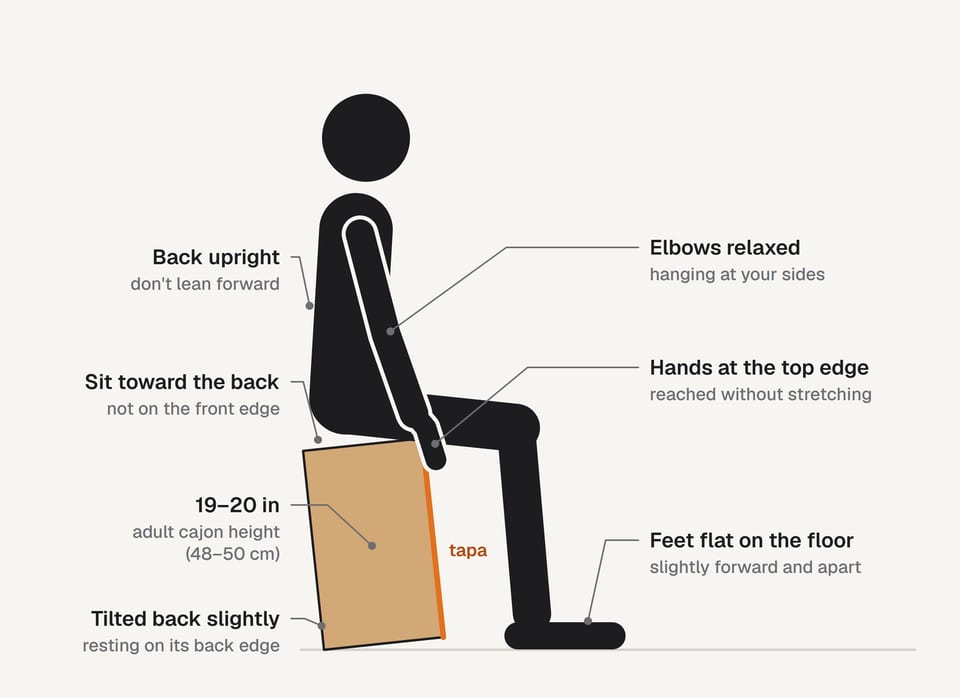
The fastest way to tell whether a cajon fits you is to sit on it. You sit astride the box, tilt it back slightly and strike the tapa between your knees (Wikipedia).
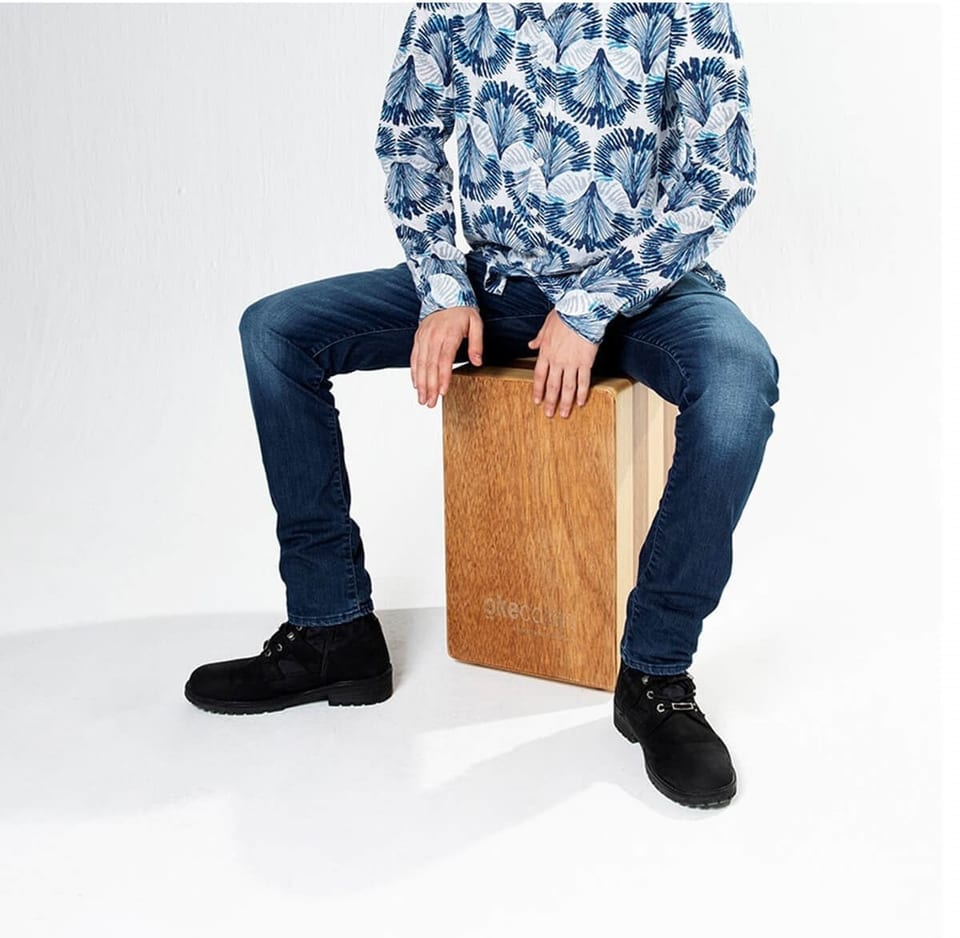
- Sit toward the back of the top, with your feet slightly forward and apart (Thomann).
- Your feet should rest flat on the floor. If you end up on your toes, the cajon is too tall for you.
- Tilt the cajon back slightly so it rests on its back edge (Thomann).
- Keep your back upright and bring your hands to the top edge of the tapa, with the cajon close enough that your elbows hang comfortably at your sides. Kopf Percussion notes that sitting too far forward or reaching for the face builds tension in the wrists and shoulders (Kopf Percussion).
How do wood and the tapa affect the sound?#
The tapa, the surface you strike, shapes the character of the sound, while the body shapes its resonance. According to Kopf Percussion, the tapa is usually a thin sheet of plywood, often birch or maple. A thinner tapa responds faster to light touches and sounds brighter, while a thicker one gives a deeper, more resonant sound (Kopf Percussion).
How the tapa is attached matters too. Schlagwerk attributes part of each series' character to the way its playing surface is fixed: a partially or fully screwed tapa has more room to vibrate (Schlagwerk FAQ). A modern cajon also has several screws at the top for adjusting its tone (Wikipedia); we explain that in cajon care and tuning.
In the traditional design, five sides are made from wood 13–19 mm (1/2–3/4 in) thick, and the tapa is a thinner sheet of plywood (Wikipedia). In Peru, cajons were built from tornillo, cedar (cedro) or mahogany (caoba), and later from moena and requia (Wikipedia, Spanish). Among today's makers, Meinl uses a 9 mm Baltic birch body on its Woodcraft series and 12 mm on its professional versions, and credits the wood with a punchy low end and crisp slaps (the sharp, high tone you get at the top edge of the tapa) (Meinl). Schlagwerk uses a high-density fiberboard (SPL) alongside birch plywood, plus a composite material it developed for tapas (SC6) (Schlagwerk FAQ).
Body size matters too. According to Kopf Percussion, the size and shape of the body affect the frequency and strength of its resonances, and the size and position of the sound hole affect pitch and volume (Kopf Percussion).
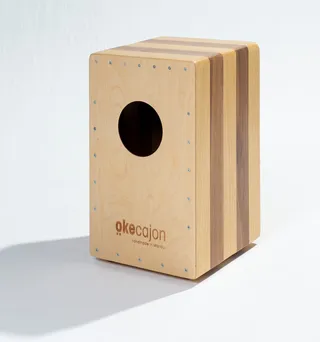
Every model in our chart has a 3 mm tapa; they differ in tapa wood and body. The S-Pro and Minish use birch for both. The Bass Cajon S-Pro pairs a 9 mm birch body with a 3 mm meranti tapa, and the Dedee pairs a 15 mm laminated walnut and ayous body with a 3 mm meranti tapa. Its product page describes the Dedee as having a sharp snare sound.
 ÖkecajonCajon DedeeCajon Dedee₺100View
Snares, strings or none? Cajon snare systems explained#
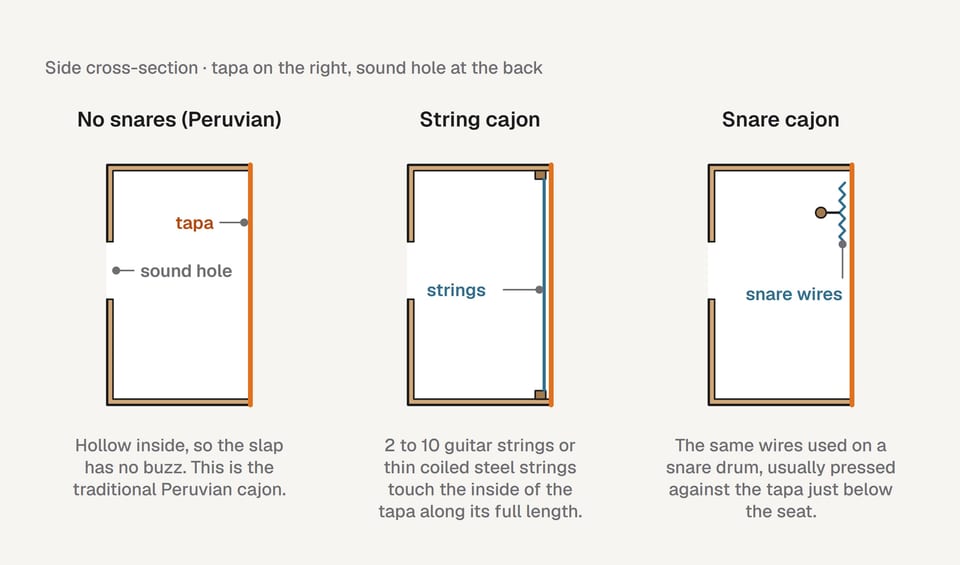
A cajon without snares is hollow inside, so the slap has no buzz; in a snare or string cajon, wires behind the tapa add a snare-drum-like buzz to the slap. Choose snares if you want that buzz, and no snares if you want a dry, traditional sound.
The traditional Peruvian cajon has no snares. According to Spanish-language Wikipedia, fitting strings inside the box was tried in the Peruvian cities of Trujillo and Chiclayo in the 1950s but didn't catch on, because some players considered it cheating. In Spain, the cajon is usually played with three or four metal strings inside, and Peruvian artists including Susana Baca have stressed that Afro-Peruvian music doesn't use the "flamenco cajon" (Wikipedia, Spanish). If you plan to play Afro-Peruvian rhythms, a cajon without snares is the closest to the tradition.
Fixed snares are the simplest system, but they can't be adjusted or muted (Cajons Made In). Snares you can adjust or switch off from the outside let one cajon cover both a buzzy sound and a nearly snare-free one, which is handy if you play several styles or record.
Snare wire counts on our product pages#
Our product pages list snare wires in a "20×2" format. The S-Pro and Bass Cajon S-Pro have 20×2, the Dedee 40×2, the Minish and our wearable cajons 20×1, and the Belly Cajon 10×1. All four of our seated cajons have snare wires; the highest count, 40×2, is on the Dedee, whose product page describes a sharp snare sound.
Wire count isn't the only factor; tension matters too. For its string cajons, Schlagwerk says the best sound comes from strings under only slight tension, and that a humming noise while you play means they're too tight (Schlagwerk FAQ).
Snare cajon vs string cajon#
A string cajon has guitar strings or thin coiled steel strings running the full length of the tapa; a snare cajon has the same wires you'd find on a snare drum, usually pressed against the tapa just below the seat. Both add buzz to the slap. They differ in construction and in how you can adjust them:
| System | What's inside | Adjustment |
|---|---|---|
| No snares (Peruvian) | Nothing; the box is hollow | None |
| String cajon | 2 to 10 guitar strings or thin coiled steel strings, running vertically and touching the inside of the tapa along its full length | Some high-end models let you tension each string with a guitar tuning machine; on others, tension is set with screws in the base |
| Snare cajon | A set of snare-drum wires, usually pressed against the tapa just below the seat | Fixed, bar-mounted, or adjustable with a knob or lever outside; some professional models switch off with a pedal |
The table draws on Cajons Made In, Meinl and the Schlagwerk FAQ.
Because each system sounds different from one model to the next, the most reliable comparison is to play both with the same groove and listen.
A note on names: our Snare Cajon (OSNC) is not a box cajon. It's a flat, round, two-sided instrument about 11.8 in (30 cm) across and 3.3 in (8.5 cm) thick, with a natural bass side and a snare side. If you're after a snare cajon in the usual sense, a box cajon with snare wires, look at the S-Pro, Dedee or Bass Cajon S-Pro.
What is a bass cajon, and who needs one?#
A bass cajon is built to bring out the low end. Meinl makes its bass cajons in sizes from standard to jumbo, with an internal bass reflex system and large, forward-facing ports that project the bass toward the audience (Meinl).
The company pitches them for gigs where a full drum set would be too much. Wikipedia likewise notes that bands often use a cajon as a bass drum in place of a full kit in minimalist settings, since it doubles as the drummer's seat (Wikipedia).
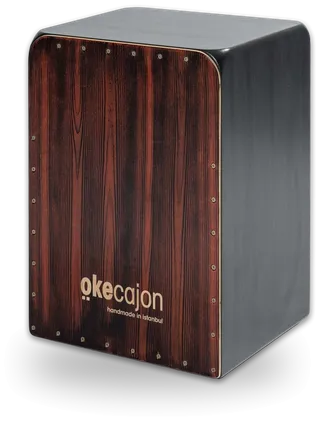
Our Bass Cajon S-Pro is the same height as the Cajon S-Pro, 19.7 in (50 cm), but one side is 14.2 in (36 cm) instead of 11.4 in (29 cm). Going by outer dimensions, that's about 24% more volume. The two differ in body size and tapa wood: the Bass Cajon S-Pro has a 3 mm meranti tapa and the S-Pro a 3 mm birch one, while both have a 9 mm birch body and 20×2 snare wires.
A bass cajon makes sense for percussionists and drummers who use a cajon in place of a drum kit or want a stronger low end at acoustic gigs. The trade-off is size: a bigger body takes up more room when you carry and store it.
 ÖkecajonBass Cajon S-ProBass Cajon S-Pro₺100View
Which cajon for beginner, intermediate and pro players?#
How you'll use the cajon matters more than your level. A beginner needs a sturdy cajon in the right size with a clearly separated bass and slap; at higher levels, snare adjustment, the option to switch snares off and materials start to matter. The table below is a general guide, and it lists criteria rather than models.
| Level | Priorities | Not essential |
|---|---|---|
| Beginner | Right size, clear bass and slap, solid build, seat pad | Adjustable snares, a bass cajon |
| Intermediate | A preferred snare system (strings or snare wires), tone adjustment, add-ons | A second cajon |
| Pro, stage and studio | Clean snare sound for recording, snares you can switch off, a sturdy gig bag, a bass cajon if needed | — |
Makers draw similar lines between their ranges. Meinl's standard snare models have fixed snares, while its Snarecraft Professional models let you adjust or throw them off with a foot pedal or knob, and its professional versions use a 12 mm body instead of 9 mm (Meinl). In our own range, the Cajon S-Pro is designed for professional percussionists, and both the S-Pro and Dedee are made for studio recording and the stage. There's nothing wrong with a beginner buying a cajon labeled "professional"; size and sound are what count. Once you have one, head to how to play cajon for your first strokes and grooves.
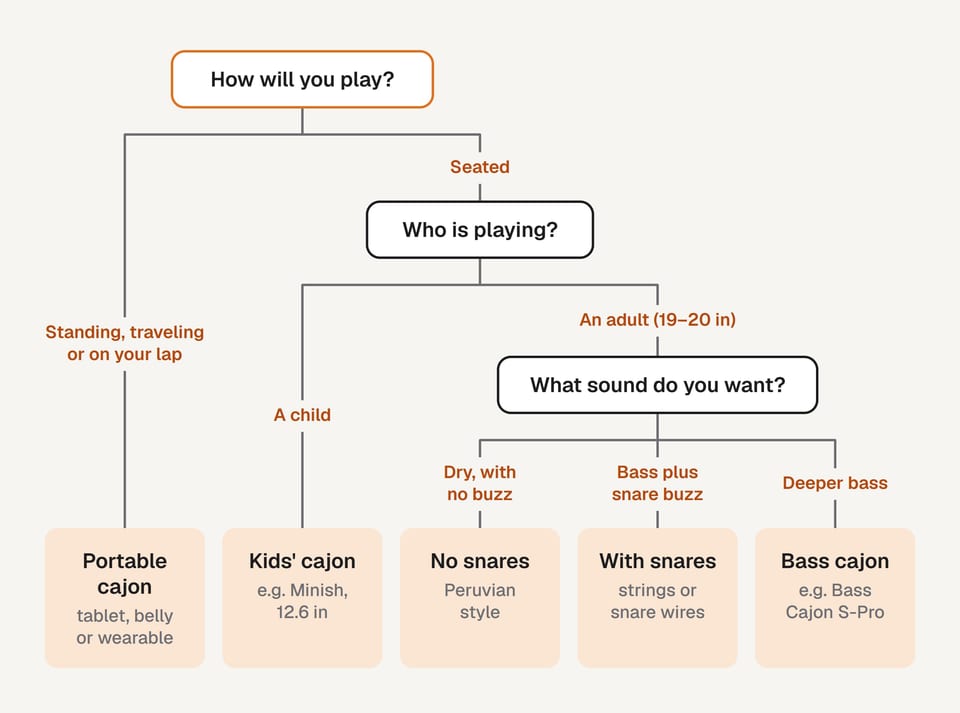
The decision tree in words:
- If you'll play standing, on the go or on your lap, look at a portable cajon: a tablet, wearable or belly cajon.
- If a child will play seated, choose a kids' size cajon, such as the 12.6 in (32 cm) Minish.
- If you're an adult, start from the standard 19–20 in (48–50 cm) size and choose by sound: no snares for a dry sound with no buzz, snares (strings or snare wires) for bass plus snare buzz, or a bass cajon for a deeper low end.
What size cajon is right for kids?#
The right cajon for a child is one they can sit on with their feet flat on the floor while reaching the top edge of the tapa without leaning forward. A 19–20 in (48–50 cm) adult cajon can be too tall for young children, so run the fit test above with your child.
Our Minish Cajon is designed for young percussionists. It measures about 8.7 × 9.1 × 12.6 in (22 × 23 × 32 cm) and weighs about 5.2 lb (2.35 kg), with a 9 mm birch body, a 3 mm birch tapa and 20×1 snare wires. It has rounded edges and comes with a faux leather carry bag and seat cushion. Repeat the test as your child grows; once their feet rest flat on the floor on a 19–20 in cajon, they're ready for a standard size.
 ÖkecajonMinish CajonMinish Cajon (kids' cajon)₺100View
Choosing a cajon for home, stage, studio or travel#
Where you'll play decides how much weight you're willing to carry and what sound you need. These pairings work well in practice:
| Where | Priorities | Best fit |
|---|---|---|
| Home and lessons | Right size, a comfortable seat (pad), rounded edges | Standard cajon with snares; kids' size for children |
| Stage | Strong bass, sturdy gig bag | Standard or bass cajon |
| Studio | Clean, balanced snare sound with no unwanted buzz | Cajon with adjustable or switchable snares, or no snares |
| Travel and busking | Light weight, a strap, fits a snare stand | Tablet, wearable or belly cajon |
Seated cajons weigh several pounds: about 10.7 lb (4.85 kg) for the S-Pro, 8.8 lb (4 kg) for the Dedee and 5.2 lb (2.35 kg) for the kids'-size Minish. The S-Pro comes with a custom Imperteks fabric bag and seat cushion, and the Dedee and Minish with a faux leather bag and seat cushion. You'll find all our full-size models in the cajon category.
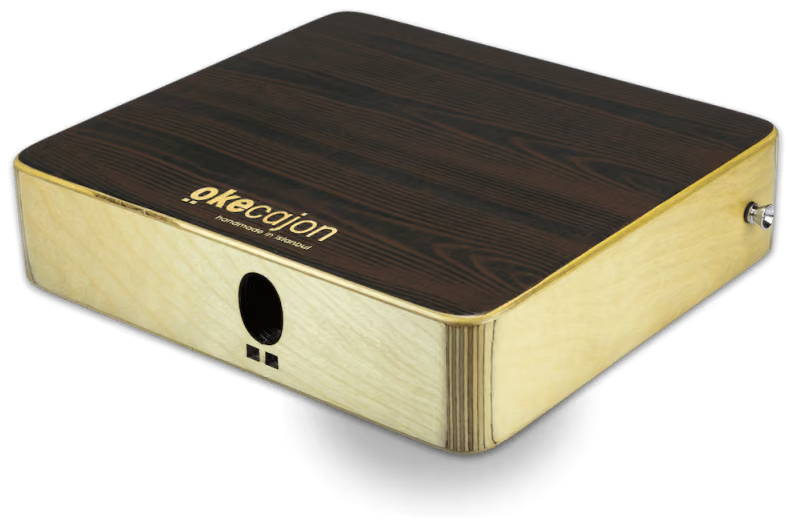
If you'll carry your cajon often, look at a portable model; they're far lighter. Our Tablet Cajon (TC-BR) weighs about 1.8 lb (800 g), is playable on both sides and fits a snare stand (stand not included). The Belly Cajon weighs about 1 lb (450 g), and both it and the Wearable Cajon take any guitar strap on their side pins. We compare them in our portable cajon guide, and you'll find them all in the percussion category.
What to look for in a handmade cajon#
In a handmade cajon, look closely at the joints, the screws, the edges and feet, and how even the snare sound is. Our checklist:
- Corners and joints: no gaps, splits or excess glue.
- Tapa and screws: all screws present and evenly spaced. Schlagwerk notes that screwed tapas can show slight waviness around the screws and slightly raised corners, which isn't a defect (Schlagwerk FAQ).
- Edges: the edges your hands and legs touch should be rounded.
- Feet: solid, non-slip feet keep the cajon from sliding and protect the floor.
- Sound: the bass in the center and the slap at the top edge should sound clearly different, with no long, unwanted buzz on bass notes.
- Inside: look through the sound hole for loose parts or glue residue.
- Product info: body and tapa wood, thicknesses, snare system, dimensions and weight should all be listed.
Our cajons are handmade in Istanbul, and we list these specs on our product pages. The S-Pro, Dedee and Minish stand on four feet made from the same rubber we use for our practice pads, and their edges are rounded for playing comfort.
If you're buying used, also check the tapa for cracks and the joints for gaps. Wood expands and contracts as humidity and temperature change, and it can warp or even crack (LP).
Buyer's checklist#
Answer these before you order:
- Who will play the cajon, where, and how: seated or standing?
- Is the size right? About 19–20 in (48–50 cm) for adults, shorter for kids. Have you done the fit test?
- What sound do you want: no snares, strings, snare wires or a bass cajon?
- Does the product page clearly list the tapa and body wood, their thicknesses and the snare system?
- Are the snares fixed, adjustable or switchable, and do you need that?
- Are the corners, screws, edges and feet well finished?
- Is the weight manageable, and are a bag and seat pad included?
- Have you played it, if possible? Listen to the bass, the slap and soft touches separately.
Frequently asked questions
What kind of cajon should a beginner buy?
A sturdy, standard-size cajon, about 19–20 in (48–50 cm) tall, that fits your height and gives a clearly separated bass and slap is all you need. Pick one with snares if you want a snare-drum-like buzz, or one without snares for a dry, traditional sound. Adjustable snares aren't essential when you're starting out.
What size cajon should I get?
A standard adult cajon is about 19–20 in (48–50 cm) tall and 12–14 in (30–35 cm) wide and deep. On the right size, your feet rest flat on the floor and you can reach the top edge of the tapa without leaning forward. Kids' cajons are shorter; our Minish Cajon, for example, is 12.6 in (32 cm) tall.
What is the best wood for a cajon?
There is no single best wood. The tapa is usually thin plywood, often birch or maple, and Meinl credits Baltic birch bodies with a punchy low end and crisp slaps, while traditional Peruvian cajons used woods such as tornillo, cedar and mahogany. Tapa thickness matters too: a thinner tapa sounds brighter and a thicker one deeper.
Should I get a cajon with snares or without?
Get snares, either strings or snare wires, if you want a snare-drum-like buzz on the slap, and no snares if you want a dry, traditional sound. The traditional Peruvian cajon has no snares, while in Spain the cajon is usually played with metal strings inside. Models with adjustable or switchable snares let you move between the two.
What is a bass cajon, and how is it different from a regular cajon?
A bass cajon is built to bring out the low end; Meinl's bass cajons, for example, have an internal bass reflex system and large, forward-facing ports. Meinl recommends them for gigs where a full drum set would be too much. Our Bass Cajon S-Pro is the same 19.7 in (50 cm) height as the Cajon S-Pro, but one side is 14.2 in (36 cm) instead of 11.4 in (29 cm).
What size cajon is right for kids?
A child should be able to sit with their feet flat on the floor and reach the top edge of the tapa without leaning forward, and a 19–20 in (48–50 cm) adult cajon can be too tall for young children. Our Minish Cajon, designed for young percussionists, is 12.6 in (32 cm) tall. The similar-sized Sanduka is not an instrument you sit on.
Are more expensive cajons really better?
Price usually reflects materials, craftsmanship and the snare system, but an expensive cajon that doesn't fit your height or your taste in sound isn't a good buy. Many differences between cajons aren't visible from the outside, so compare the specs and play the cajon before you buy if you can.
Sources#
- Cajón — Wikipedia
- Cajón (percusión) — Wikipedia (Spanish)
- Understanding the Anatomy and Physics of Cajon Drums — Kopf Percussion
- Learning Cajon the Right Way — Kopf Percussion
- What is Inside a Cajon? — Cajons Made In
- Woodcraft and Snarecraft Cajons — Meinl Percussion
- Bass Cajons — Meinl Percussion
- FAQ – Frequently Asked Questions — Schlagwerk
- Cajon Playing Techniques — Thomann
- FAQ — LP (Latin Percussion)
Instruments in this article
Shop Cajon →




More from the Academy
Rhythm Academy →
Cajon
What Is a Cajon? Origins, Anatomy, Sounds and Types
A cajon is a box-shaped percussion instrument from Peru that you sit on and play with your hands. See how it's built, how it sounds and its main types.
20 min read
Cajon
How to Play Cajon: Posture, Basic Strokes and Your First Groove
Learn cajon step by step: how to sit, where to hit for bass and slap, tones and ghost notes, your first 4/4 groove and a 30-day practice plan.
17 min read
Practice Pad
What Is a Practice Pad? What It's For and How to Use One
A practice pad is a quiet surface drummers use to build stick control and warm up. Learn what it does, how to set it up and use it, and what it can't do.
16 min read