How to Play Cajon: Posture, Basic Strokes and Your First Groove
Learn cajon step by step: how to sit, where to hit for bass and slap, tones and ghost notes, your first 4/4 groove and a 30-day practice plan.
Ökecajon Workshop17 min read
In this article
- What do you need to start playing cajon?
- How do you sit on a cajon?
- Is your cajon the right height?
- Should you tilt the cajon?
- Where do you hit a cajon?
- How do you play the bass tone?
- How do you play a slap on the cajon?
- What are tones and ghost notes?
- Your first groove: the basic 4/4 cajon beat
- How to practice cajon with a metronome
- A 30-day cajon practice plan
- 7 common beginner mistakes
- Why do my hands hurt when I play cajon?
- Frequently asked questions
- Sources
The cajon (pronounced kah-HOHN) is a box-shaped percussion instrument from Peru that you sit on and play with your hands; our guide What is a cajon? covers its history, its parts and how it makes sound. This one starts from zero and goes in order: posture, the four basic sounds, your first groove and a 30-day practice plan with a metronome. The good news is that Thomann's cajon guide describes the technique as relatively easy to learn, with beginners getting a good sound fairly quickly (Thomann).
What do you need to start playing cajon?#
All you need is a cajon that fits your height, a metronome and a room where you can make some noise. You don't need sticks, a pedal or any other accessories, and a metronome app on your phone works fine. You don't need a stool either, because you sit on the instrument itself.
The size chart in our guide to choosing a cajon will help you find the right model. Our full-size cajons are in the cajon category, and our kids' and portable models are under percussion:
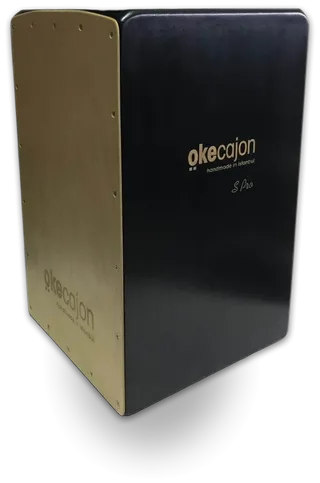
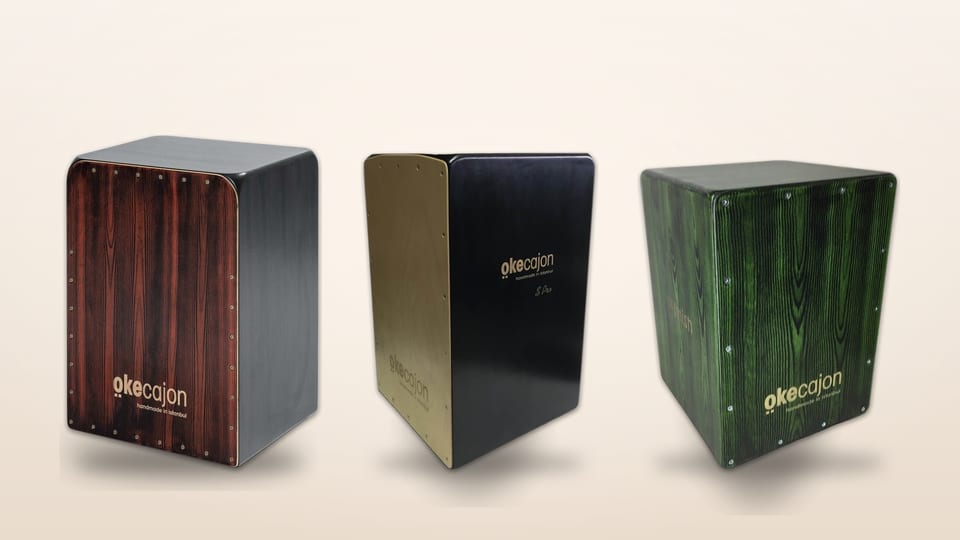
- Full size: the Cajon S-Pro (CSP-S) has a 9 mm birch body and a 3 mm birch tapa and measures approx. 11.4 x 11.8 x 19.7 in (29 x 30 x 50 cm). The Cajon Dedee (CDD) has a 15 mm laminated walnut and ayous body and a 3 mm meranti tapa, approx. 11.4 x 12.2 x 18.9 in (29 x 31 x 48 cm).
- For kids: the Minish Cajon (MSH) is designed for young percussionists and measures approx. 8.7 x 9.1 x 12.6 in (22 x 23 x 32 cm).
- To take with you: the Tablet Cajon (TC-BR) and Square Tablet Cajon (KTC) aren't box cajons you sit on; they're lightweight models that can go on a snare stand, and tablet cajons like these are also played on the lap. Our portable cajon guide compares them.
The S-Pro, Dedee and Minish are 100% handmade, and all three come with a carry bag and a seat cushion. The posture and strokes in this guide are for box cajons like these, the kind you sit on.
 ÖkecajonCajon S-ProCajon S-Pro₺100View
How do you sit on a cajon?#
Sit astride the cajon toward the back of the seat, with your feet on the floor a little in front of the box and out to either side, and keep your back straight (Thomann). The tapa faces forward, between your knees (Wikipedia).
- Set the cajon on a flat floor with the tapa facing the same way you do.
- Sit toward the back of the seat. Rhythm Notes suggests the back two-thirds (Rhythm Notes), and Thomann points out that this gives both hands easy access to the upper part of the tapa.
- Put both feet flat on the floor, a little in front of the cajon and to the left and right of it.
- Straighten your back and let your shoulders drop.
- Keep the cajon close enough that your elbows can hang comfortably at your sides (Kopf Percussion).
- If you like, tilt the cajon slightly back (see the next section).
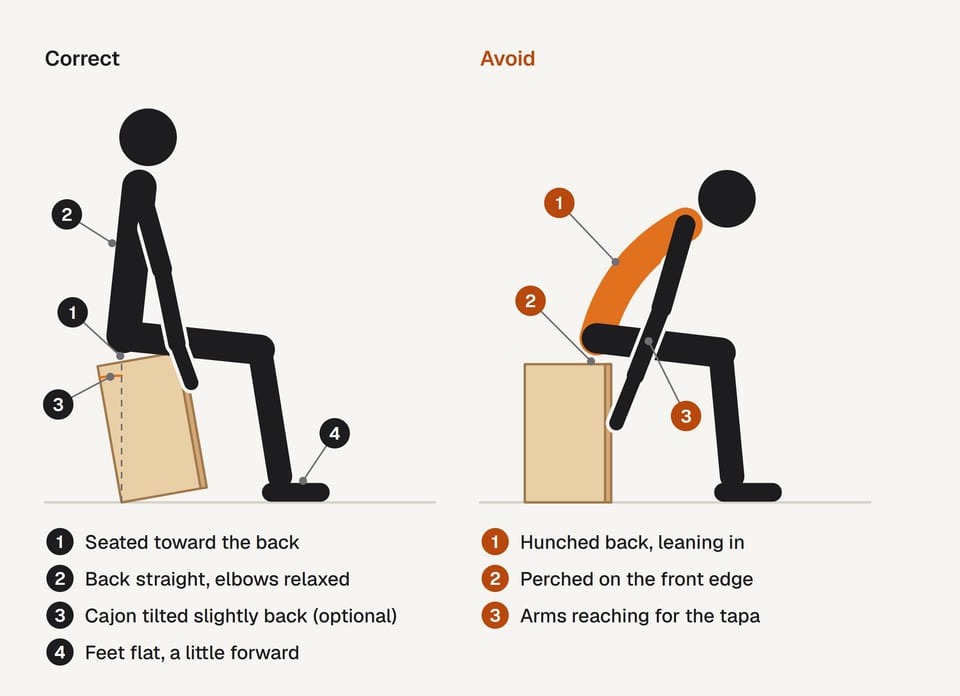
A common mistake is reaching forward. According to Kopf Percussion, sitting too far forward or reaching for the face builds tension in your wrists and shoulders, while an upright spine, loose elbows and hands close to the body keep the motion efficient. If you find yourself reaching, slide back on the seat and straighten up.
Is your cajon the right height?#
When you sit down, both feet should rest flat on the floor and you should reach the top edge of the tapa without rounding your back. Spanish Wikipedia gives the cajon's height as about 19 to 20 in (48–50 cm) (Wikipedia, Spanish). That can be too tall for kids; if a child's feet don't reach the floor, they need a smaller model such as the Minish Cajon.
 ÖkecajonMinish CajonMinish Cajon (kids' cajon)₺100View
Should you tilt the cajon?#
You don't have to. What matters is reaching the top edge of the tapa without rounding your back. Wikipedia describes players tilting the cajon at an angle, and Thomann recommends tilting it back a little because it lets you straighten your back and reach the playing surface more easily. Rhythm Notes doesn't mention tilting at all; it tells you to keep your back straight and bend forward just enough to reach the playing area.
When you tilt the cajon, it rests on its back bottom edge and the front feet lift slightly off the floor. Keep your balance with both feet and never lean it so far that it could tip over.
Where do you hit a cajon?#
Every basic sound comes from the tapa: the slap and the tone are played at and just below the top edge, and the bass lower down, toward the center. As Kopf Percussion puts it, striking the center produces low-frequency bass, while striking toward the edges produces high, snare-like sounds (Kopf Percussion).
Sources describe the bass position a little differently. Kopf places a relaxed palm near the center of the faceplate. Thomann, while acknowledging that many people play it otherwise, says you should only play the top third of the surface; in its version of the bass stroke, the heel of your hand sits at about the height of the top edge. What they agree on is that your hand is flat and lower for the bass than for the slap.
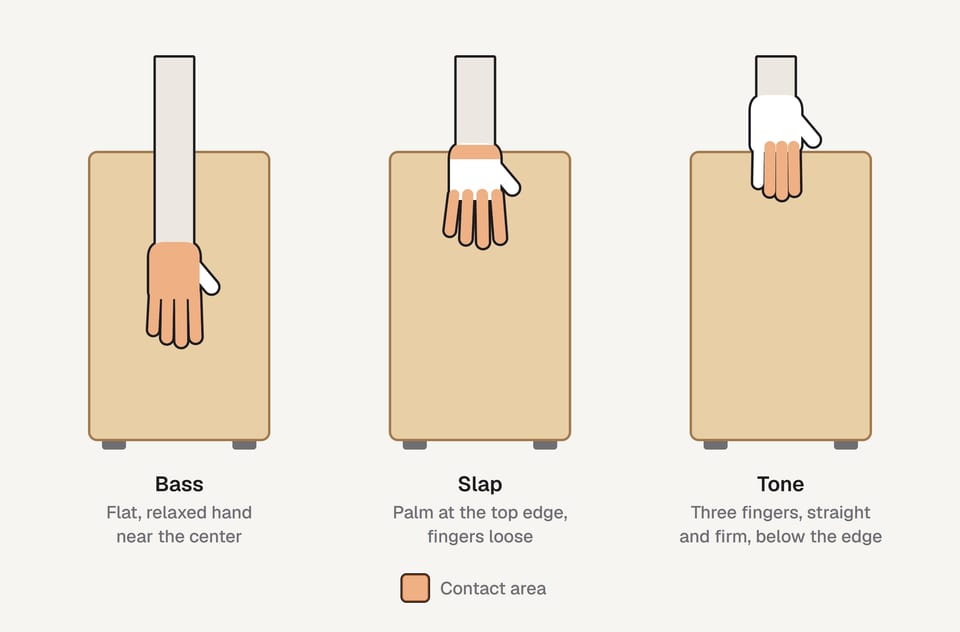
| Stroke | Where on the tapa | Hand | Sound |
|---|---|---|---|
| Bass | Toward the center, lower than the slap | Flat and relaxed, using the weight of the arm | Low, full |
| Slap | Top edge | Palm at the edge, loose fingers snap onto the face | High, sharp |
| Tone | Just below the top edge | Three fingers, straight and firm | High |
| Ghost note | Wherever your hand is | Fingers, very lightly | Felt more than heard |
You can also play the sides with the top of your palms and fingers for extra sounds (Wikipedia). Skip that for now and focus on getting a clear difference between bass and slap.
How do you play the bass tone?#
Strike the tapa with a flat, relaxed hand and let it bounce off right away. According to Rhythm Notes, almost your whole hand touches the face, and it has to come off the tapa right after the stroke so the wood can resonate and give you a full bass (Rhythm Notes).
- Relax your hand, with your fingers straight and slightly apart.
- Bring your palm to a spot near the center of the tapa. Because you reach down from the seat, your fingers point toward the floor.
- Don't force the stroke. Thomann suggests simply letting the weight of your arm do the work, and Rhythm Notes describes the bass as a wrist and arm movement.
- Let your hand bounce off the moment it makes contact. Thomann notes that a hand left on the surface muffles the bass.
If the bass sounds weak or short, first check whether your hand is staying on the tapa, then whether you're hitting too high. Kopf's fix when the bass disappears: move closer to the center and relax your palm. Technique isn't the only factor, though; according to Kopf, the volume of air inside the body and the cajon's dimensions also shape the bass.
How do you play a slap on the cajon?#
The slap comes from the wrist: with your palm at the top edge of the tapa, your relaxed, extended fingers strike the upper part of the face and bounce straight back (Thomann). Thomann says the slap should sound clearly different from the bass, and that contrast is what makes your groove easy to follow.
- Move your hand up from the bass position until your palm is at the top edge.
- Keep your fingers loose; don't tense them.
- Strike with a short, fast wrist motion so your fingers snap onto the upper part of the tapa.
- Let your fingers bounce right off.
Rhythm Notes describes it slightly differently: the middle of your palm contacts the drum and your relaxed fingers carry on forward to make the slap. Kopf boils it down to "relax the hand on bass; quick release on the slap," and if the slap cuts too sharp, it suggests shifting slightly lower and shortening the contact. Thomann adds that the sweet spot varies from cajon to cajon, so expect to experiment a little.
The character of the slap also depends on the instrument. On cajons with snare wires (the kind used on a snare drum) behind the tapa, the wires add a snare-like buzz to the high strokes. The Cajon Dedee, for example, has 40×2 snare wires and is described on its product page as having a sharp snare sound.
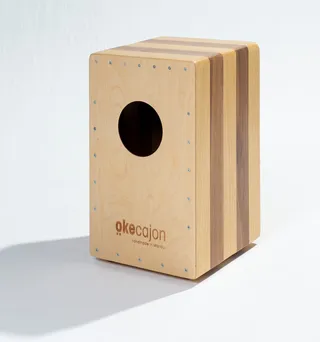 ÖkecajonCajon DedeeCajon Dedee₺100View
If a cajon with wires keeps humming while you play, the problem may be the wire adjustment rather than your technique. Schlagwerk says that on its own cajons with string systems, humming while you play means the strings are already too tight (Schlagwerk). We cover tapa screws, wires and care in our cajon care and tuning guide.
What are tones and ghost notes?#
The tone is the third basic sound next to bass and slap: you strike the upper part of the tapa with three fingers held straight and firm. A ghost note is a very light touch that fills the gaps in a groove and is felt more than heard.
Tone. Rhythm Notes calls this the "high tone" and describes playing the upper face with three fingers, just below the knuckles, keeping them straight and rigid so they don't stay on the face. Thomann instead describes a "high slap" played with the fingertips at the very top of the surface, which should be noticeably quieter than the slap. You can play tones instead of slaps on beats 2 and 4 of the basic groove.
The names vary from source to source. Artdrum, writing about Afro-Peruvian playing, calls the low sound played with the full palm in the middle the "tone" or bass, and the sound played at the edge the slap (Artdrum). When a teacher or a video says "tone," check which sound they mean.
Ghost notes. Rhythm Notes calls these touch strokes, notes that they are also known as grace notes or ghost notes, and describes them as light strokes that are felt more than heard. Kopf's first-week plan holds them back at first: soft ghost taps come in only on days 4 to 7. One approach that works well in practice is to keep your hand very close to the tapa and touch it with your fingertips only, so the bass and slap stay in front and the ghost notes sit in the background.
According to Thomann, techniques from other hand drums such as the conga, bongo and doumbek can also be used on the cajon for special effects and rolls. Save those for after the basic sounds feel solid.
Your first groove: the basic 4/4 cajon beat#
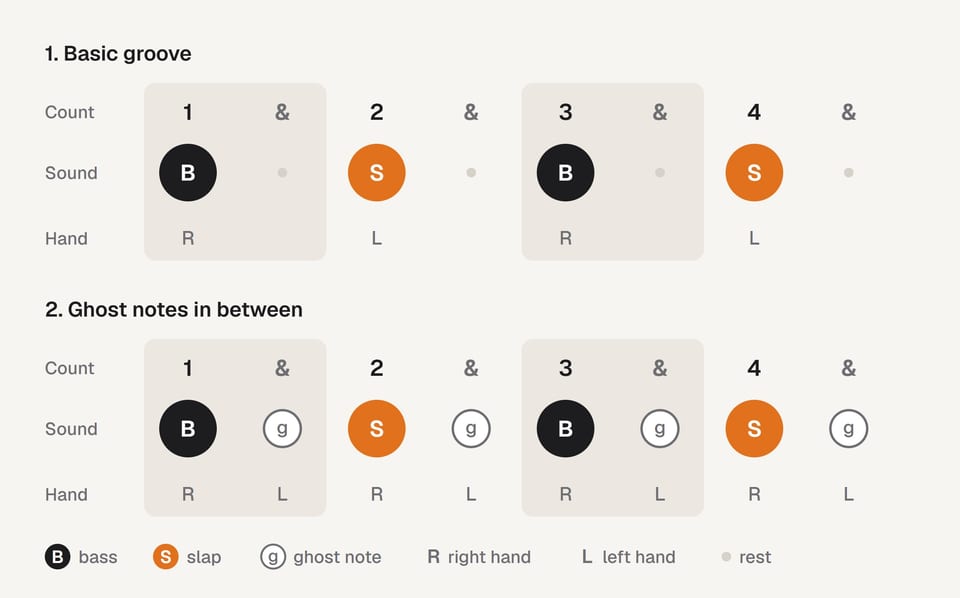
In the basic cajon groove, the bass falls on beats 1 and 3 and a high sound on beats 2 and 4: B . S . B . S . Rhythm Notes calls this pattern "Boom Wack" and plays it with high tones on 2 and 4 (Rhythm Notes); with slaps, the groove is the same. A 4/4 bar has four beats, and when you count eighth notes you say "one and two and three and four and," written below as 1 & 2 & 3 & 4 &.
In the grids, B is bass, S is slap, g is a ghost note and a dot (.) is a rest. In the hand row, R is your right hand and L your left.
1. Basic groove
| 1 | & | 2 | & | 3 | & | 4 | & | |
|---|---|---|---|---|---|---|---|---|
| Sound | B | . | S | . | B | . | S | . |
| Hand | R | . | L | . | R | . | L | . |
Play the bass with your right hand and the slap with your left; if you're left-handed, swap them.
2. Ghost notes in between
| 1 | & | 2 | & | 3 | & | 4 | & | |
|---|---|---|---|---|---|---|---|---|
| Sound | B | g | S | g | B | g | S | g |
| Hand | R | L | R | L | R | L | R | L |
Next, add a ghost note with your left hand on every "and." Because your hands now alternate (R L R L), the slap moves to your right hand. Alternating hands makes faster tempos easier, but treat this sticking as a suggestion, not the only correct one.
Once both patterns feel easy, move on to pop, rock, funk and 6/8 grooves; our cajon rhythms guide covers them with notation grids.
How to practice cajon with a metronome#
Set the metronome to a slow tempo you can play without mistakes and stay there until the groove feels comfortable and natural; then speed up in small steps. BPM means beats per minute, so 60 BPM is one beat per second.
- Pick a starting tempo. Kopf Percussion has students start around 70 to 80 BPM, "slow enough to feel every movement," and its first-week plan spends days 1 to 3 at 72 BPM and days 4 to 7 at 78 BPM. If that feels fast, start at 60.
- Count along. For the first few days, set the metronome to click eighth notes, then switch to a click on the beat only once the groove settles; Kopf's plan works the same way. Counting "one and two and" out loud helps too.
- Play four clean bars. A practical rule of thumb: don't change the tempo until you can play the pattern four bars in a row without a mistake.
- Go up 4 to 5 BPM. Small steps help keep mistakes from turning into habits.
- Step back when it falls apart. Return to the previous tempo and play four clean bars there again.
- Play softly. Kopf recommends practicing soft first: play the pattern as quietly as you can while keeping every note even, because "that's where tone lives." Add volume later.
Drummers practice their basic sticking patterns, the rudiments, in a similar way: the Percussive Arts Society (PAS) recommends working each rudiment from slow to fast and back to slow (PAS). You can play sticking patterns from our drum rudiments guide, such as single strokes (R L R L), as ghost notes on the cajon to even out your hands.
A 30-day cajon practice plan#
This plan takes 15 to 20 minutes a day for the first three weeks and starts with posture and the two core sounds. The goal for week one is to play the basic 4/4 groove with a metronome; by day 30, you should be playing the basic and ghost-note grooves along with songs, with simple fills. The plan is a practice suggestion; its tempos build on the 72 and 78 BPM that Kopf uses for the first week. If you don't reach a stage's goal, repeat it before moving on.
| Days | Goal | Exercise | Time | Tempo |
|---|---|---|---|---|
| 1–3 | Posture, bass and slap | One bass per click, hands alternating (R L R L); then one slap per click; then 4 bass + 4 slap | 15 min | 60–72 BPM |
| 4–7 | Basic groove | B B S S, then B . S . B . S . counted in eighth notes | 15–20 min | 72–78 BPM |
| 8–14 | Ghost notes | B g S g B g S g, switching with the basic groove every 4 bars | 20 min | 72–84 BPM |
| 15–21 | Fills and dynamics | 3 bars of groove + 1 bar of eighth-note slaps; play each groove softly, then louder | 20 min | 78–90 BPM |
| 22–30 | Playing along | Both grooves with slow and mid-tempo songs you like; record yourself once a week | 20–30 min | The song's tempo |
Start each session with two or three minutes of warm-up: shake out your hands and tap the tapa with light, even strokes. At the end of each week, record yourself and compare it with the previous recording.
7 common beginner mistakes#
Most of these mistakes come from tension or rushing. The table shows what each one does and how to fix it.
| Mistake | What happens | What to do instead |
|---|---|---|
| 1. Reaching forward | Tension builds in your wrists and shoulders | Slide back on the seat, straighten your back, let your elbows hang at your sides |
| 2. Leaving your hand on the tapa | The bass gets muffled | Let your hand bounce off the moment it makes contact |
| 3. Playing the bass too high | The bass disappears | Move toward the center and relax your palm |
| 4. Heavy, tense hands | The sound gets choked and your hands tire quickly | Play the slap from the wrist and the bass with the weight of your arm, keeping your hands loose |
| 5. Speeding up too soon | Mistakes turn into habits | Don't change tempo until you can play four clean bars |
| 6. Practicing without a metronome | You don't notice rushing or dragging | Use a metronome every session and record yourself |
| 7. Making early sessions too long | Sore hands, more tension | Start with 15 to 20 minutes a day and take breaks |
The first four are based on the technique descriptions by Kopf Percussion, Thomann and Rhythm Notes; the last three are general practice advice.
Why do my hands hurt when I play cajon?#
You may feel some tenderness in your palms and fingers at first. Likely causes are hitting too hard, tensing your hands or striking the edge with bony parts of your hand. Wikipedia notes that some hard-hitting players wear protective drumming gloves to guard against bruises and blisters (Wikipedia).
- Don't hit too hard. Rhythm Notes points out that a cajon can only get so loud, and past a certain volume, harder strokes hurt the sound quality. In Thomann's description, too, the slap is a stroke from the wrist.
- Keep your hands loose. As Kopf puts it, "heavy hands close it down; balanced touch brings it alive."
- Don't hit the edge with your knuckles. On a slap, your palm meets the edge and your loose fingers snap onto the tapa.
- Keep sessions short. Kopf's first-week plan uses 10-minute daily sessions; the plan in this guide suggests 15 to 20 minutes including a warm-up. Rest your hands when they get tired.
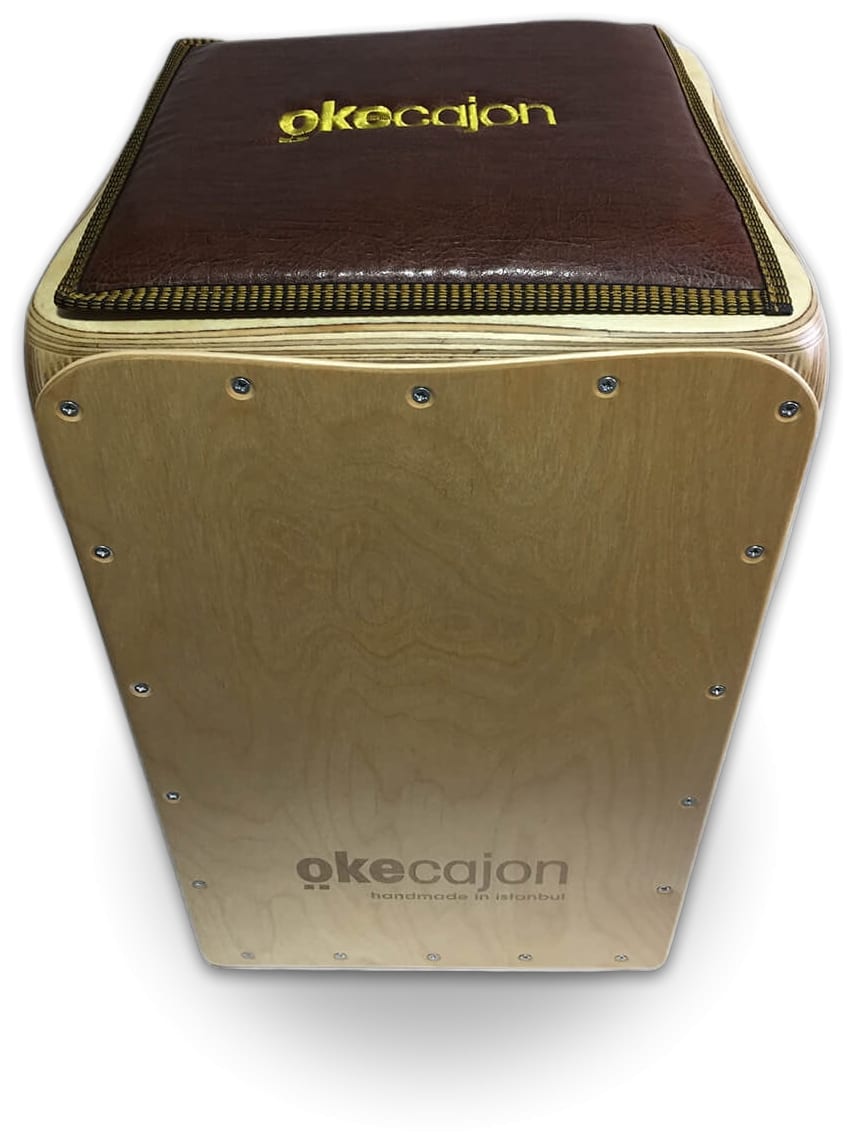
The shape of the edges affects comfort too. The Cajon S-Pro, Cajon Dedee and Minish Cajon all have rounded edges for playing comfort.
Frequently asked questions
Is the cajon easy to learn?
Yes, at the beginner level. Thomann describes the technique as relatively easy to learn and says even beginners can get a good sound fairly quickly. The real work is holding a groove at a steady tempo with a clear difference between bass and slap, and that comes from regular, slow practice with a metronome.
How long does it take to learn cajon?
It depends on how often you practice and what styles you want to play, so there is no single answer. The plan in this guide aims to have you playing the basic groove with a metronome by the end of week one, and playing along with songs, with simple fills, by day 30. Every other groove builds on that foundation.
Can I teach myself cajon?
Yes, at least for the basics. Practicing with a metronome and recording yourself give you much of the feedback a teacher would, and Kopf Percussion recommends recording yourself from day one. A few lessons to check your posture and hand technique can still catch bad habits early.
Do you need gloves to play cajon?
No, the cajon is usually played with bare hands. Wikipedia notes that some hard-hitting players wear drumming gloves to protect against bruises and blisters. As a beginner, look at your technique first: relaxed hands, strokes from the wrist and short sessions.
Can you play cajon with brushes?
Yes. According to Wikipedia, the cajon is sometimes played with brushes, mallets or sticks as well as hands, including the plastic and metal brushes used on drum kits. It also describes a metal-brush technique for playing jazz and funk grooves on the cajon.
Can you play a cajon with a bass drum pedal?
Yes. Wikipedia notes that some percussionists attach an ordinary bass drum pedal so they can play the cajon with one foot, leaving their hands free for other instruments. The trade-off is that with the cajon on the floor in the bass drum position, it becomes hard to play it with your hands.
Sources#
- Cajón — Wikipedia
- Cajón (percusión) — Wikipedia (Spanish)
- Cajon: Playing Techniques — Thomann Online Expert
- Learning Cajon the Right Way — Kopf Percussion
- Understanding the Anatomy and Physics of Cajon Drums — Kopf Percussion
- How to Play Cajon: Essential Techniques and Rhythms — Rhythm Notes
- Cajon and Afro-Peruvian Percussion — Artdrum
- FAQ — Schlagwerk
- Rudiments — Percussive Arts Society
Instruments in this article
Shop Cajon →


More from the Academy
Rhythm Academy →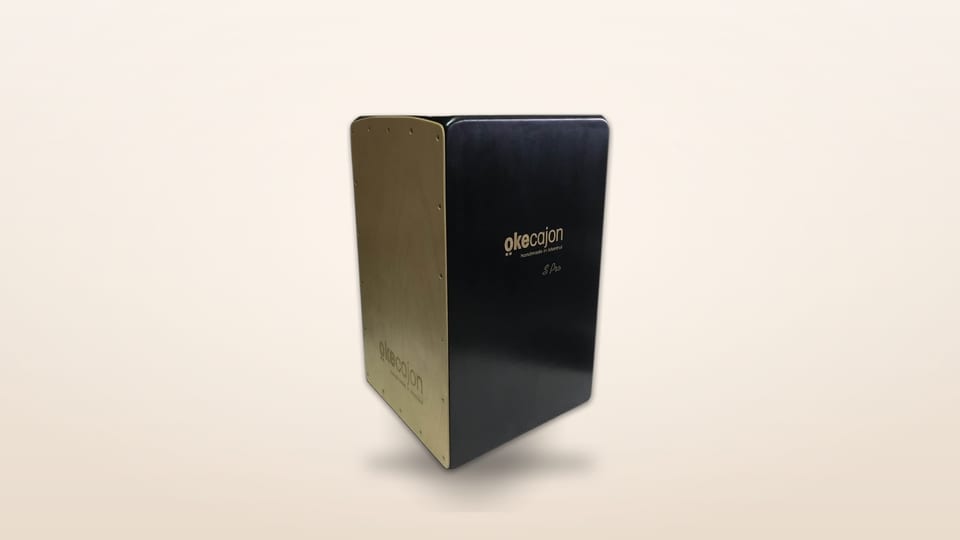
Cajon
What Is a Cajon? Origins, Anatomy, Sounds and Types
A cajon is a box-shaped percussion instrument from Peru that you sit on and play with your hands. See how it's built, how it sounds and its main types.
20 min read
Cajon
How to Choose a Cajon: Size Chart, Wood, Snares and Skill Level
How to choose a cajon: a size chart for adults and kids, how wood and the tapa shape the sound, snare vs string cajons, bass cajons and a buyer's checklist.
17 min read
Practice Pad
What Is a Practice Pad? What It's For and How to Use One
A practice pad is a quiet surface drummers use to build stick control and warm up. Learn what it does, how to set it up and use it, and what it can't do.
16 min read