What Is a Practice Pad? What It's For and How to Use One
A practice pad is a quiet surface drummers use to build stick control and warm up. Learn what it does, how to set it up and use it, and what it can't do.
Ökecajon Workshop16 min read
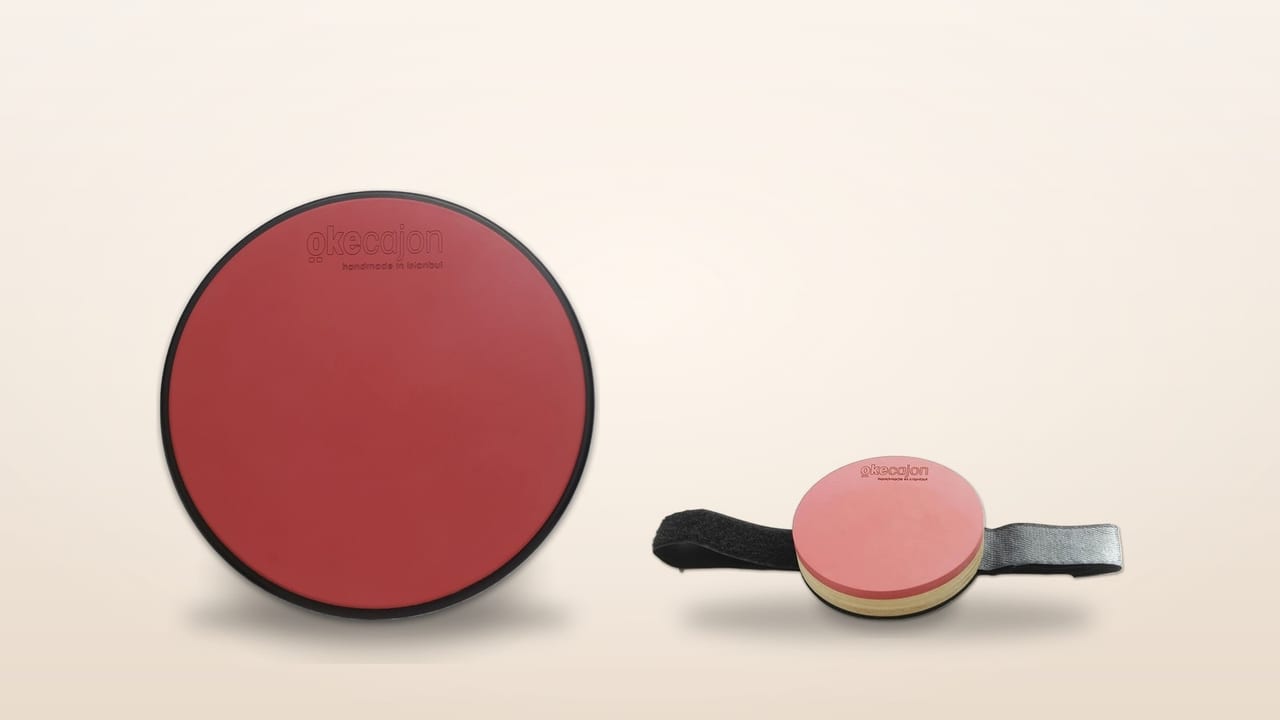
In this article
- What is a practice pad used for?
- Practice pad vs. snare drum: what's the difference?
- Can you learn drums on just a practice pad?
- What are practice pads made of?
- What types of practice pads are there?
- How to set up a practice pad: height, angle and posture
- Where can you put a practice pad?
- Step-by-step setup
- How to use a practice pad: your first 10 minutes
- How to hold drumsticks: a quick guide
- How loud is a practice pad? Practicing in an apartment
- How to care for a practice pad
- Which practice pad should you buy?
- Frequently asked questions
- Sources
A practice pad, also called a drum pad, doesn't replace a drum: it's a tool for working on your hands quietly, almost anywhere. What a pad is best for depends on its surface, its size and how it mounts. Ökecajon's practice pads are handmade in Istanbul, and most have a natural rubber or polyurethane (puff) playing surface on a wooden base.
What is a practice pad used for?#
A practice pad lets you work on hand technique away from the drum kit. By repeating the same strokes quietly, anywhere and with a metronome, you build control, speed and evenness between your hands. Wikipedia describes it as equipment drummers and other percussionists use to practice quietly or to warm up before a performance (Wikipedia).
Regular pad work helps with:
- Stick control: deciding where, from what height and how hard each stroke lands.
- Rudiments: the short sticking patterns that are the building blocks of longer, more complex drum parts, such as single strokes, double strokes and paradiddles. The standard list the Percussive Arts Society (PAS) published in 1984 has 40 of them (Wikipedia); they're all in our guide to the 40 drum rudiments.
- Timing: rudiments are traditionally practiced on a pad with a metronome.
- Hand balance: getting your weaker hand to match your stronger one in volume and spacing. The paradiddle (R L R R L R L L), for example, switches the lead hand every four notes.
- Dynamics: separating accented and soft strokes within the same pattern.
- Warming up: getting your hands and wrists ready before a rehearsal or a gig.
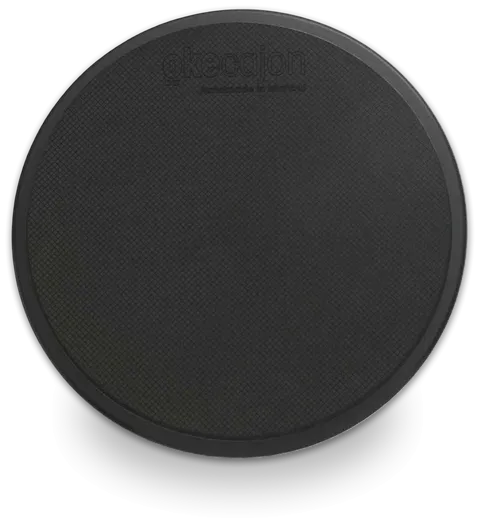
- Quiet, portable practice: Vic Firth says that even at full force its pad "absorbs the blows and controls the volume for longer and later practice" (Vic Firth). For a sense of scale, Ökecajon's 6-inch Practice Pad (PR-6) measures about 6.7 in (17 cm) across its wooden base and weighs about 450 g (1 lb).
Practice pad vs. snare drum: what's the difference?#
A pad is much quieter and more portable than a snare drum, but it can't give you the sound and response of a real drumhead or the movement a drum kit demands. Writing for Yamaha, Paul Winterhalter points out that a pad feels different from an actual drum and that practicing only on a pad doesn't develop your ear for the sound you get from your instrument (Yamaha Hub).
To understand the difference in feel, it helps to know about rebound: how much the stick bounces back off the surface after a stroke. On a pad, rebound depends on the surface material and how hard it is; on a drum, it depends on head tension.
| Practice pad | Snare drum and kit | |
|---|---|---|
| Volume | Low; you still hear a short tap from the stick | Loud; the full sound of the head and snares |
| Feel and rebound | Depends on the surface: some mimic a drumhead's response, others give less rebound to work your muscles | Depends on head tension |
| Tone | No drum tone, so it won't train your ear to fix your sound | You hear the quality of each stroke and can correct it |
| Skills | Hands: stick control, rudiments, timing | Hands and feet, moving around the kit, balancing the drums |
| Carrying and setup | Fits in a bag; a table, your knee, a stand or a drum will do | Needs stands, cases and a dedicated practice spot |
So treat a pad as a companion to the drum, not a substitute: build your hands on the pad, and learn sound and movement at the kit.
Can you learn drums on just a practice pad?#
You can develop your hands very well on a pad, but playing drums also takes foot coordination, moving around the kit and adjusting your sound by ear. The most effective approach combines pad work with time on a real drum and footwork on a kick pad or pedal.
The Yamaha piece makes the same case: practice on a real drum when you can, use a metronome through a speaker or headphones, and play in front of a mirror to catch technical mistakes. A balanced routine built on that advice looks like this:
- Do your daily hand work on the pad, with a metronome.
- Practice your pedal technique on a kick pad.
- Get on a real drum or kit regularly, and try out the patterns you've learned on the pad.
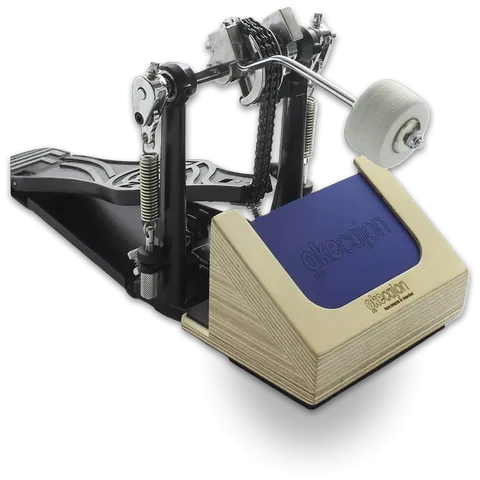
Ökecajon's Kick Pad (Kp-01) is built for footwork. It's handcrafted from birch, works with double (twin) pedals, and has four different playing surfaces and a sound-absorbing, non-slip base. It comes with one kick pedal beater; the pedal itself isn't included.
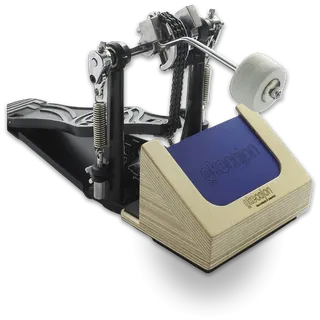 ÖkecajonKick PadKick Pad – Kick Drum Practice Pad, Drum Pad₺100View
What are practice pads made of?#
A practice pad usually has a playing surface for the sticks, a rigid base underneath and a non-slip bottom; some models also have a threaded insert for mounting on a stand. Many pads use a thin layer of natural or synthetic rubber, in various densities, as the playing surface. Some pads stretch Mylar, the material used in drumheads, over foam or rubber, while mesh pads are quieter than rubber or Mylar and can be tuned to mimic different drumheads (Wikipedia).
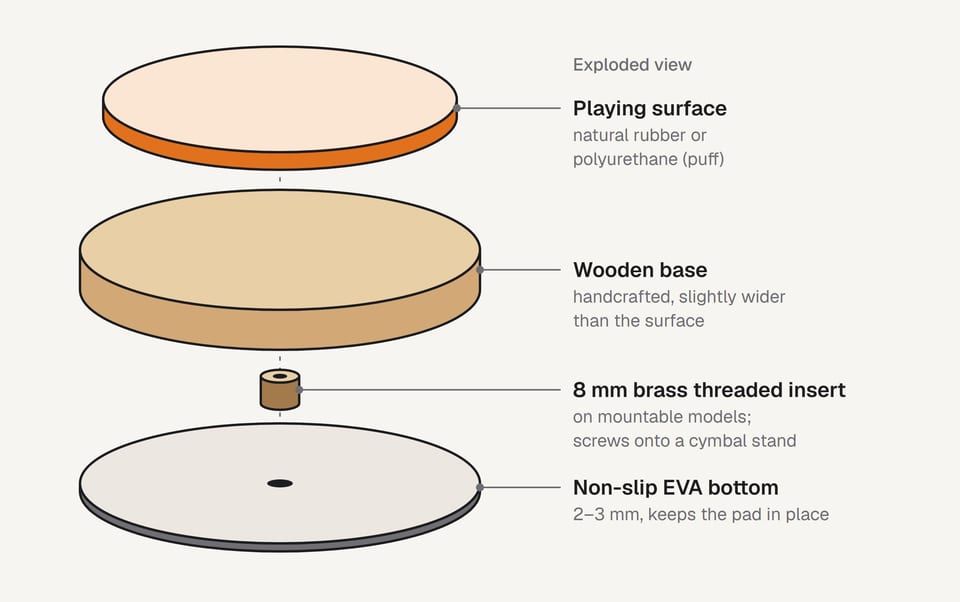
Here's how an Ökecajon pad is put together:
- Playing surface: high-quality natural rubber, or puff. On Ökecajon pads, "puff" means a polyurethane surface; it isn't rubber, and it has low rebound.
- Wooden base: handcrafted and, on most models, slightly wider than the playing surface. On the 12-inch PR-12 Single-Sided, for example, the rubber measures about 11.8 in (30 cm) across and the wood about 12.6 in (32 cm); the pad is 1.1 in (2.8 cm) thick and weighs 1570 g (about 3.5 lb).
- Non-slip bottom: many models have a 2–3 mm EVA (ethylene-vinyl acetate) layer underneath; on the PR-12 it's 3 mm. The knee pads use a two-level non-slip base instead.
- 8 mm brass threaded insert: found on mountable models, it lets you screw the pad onto a cymbal stand. Other brands use the same size: the Evans 7-inch Apprentice pad, for instance, has an 8 mm threaded insert for mounting to most standard cymbal stands (D'Addario).
Pad sizes are given in inches (1 in = 2.54 cm). On Ökecajon pads, the size roughly matches the playing surface: a 12-inch pad has a surface of about 30 cm, a 10-inch about 25 cm, a 6-inch about 15 cm and a 4-inch about 10 cm. The illustration above is drawn to the proportions of a 6-inch mountable pad: a playing surface of about 6 in (15 cm), a wooden base of about 6.7 in (17 cm) and an overall thickness of 1.1 in (2.8 cm).
What types of practice pads are there?#
Practice pads differ by surface material, number of playing surfaces and how they mount. The basic type is a single-sided rubber pad for a table or stand; the other types are designed for a specific need, such as lower volume, a different rebound, a snare sound or playing on your knee.
| Type | What sets it apart | Best for | Ökecajon example |
|---|---|---|---|
| Single-sided rubber | Natural rubber surface on a wooden base | Everyday hand practice | PR-12 Single-Sided |
| Puff (polyurethane) | Not rubber; low rebound | Low-volume, low-rebound practice | Pop-12 Puff |
| Double-sided or multi-surface | Two or three surfaces with different feel and rebound | Switching rebound on one pad | PRDS-12 Double-Sided, PRMS-12 Three-Surface |
| Snare sound | Metal beads inside the wooden body | Practicing with a snare-like sound | Poss-10 Snare Pad |
| Knee pad | Small pad that straps to your thigh | Warm-ups, travel, backstage | 4-inch Knee Pad |
| Mountable | 8 mm brass threaded insert | Mounting on a cymbal stand next to the kit | 6-inch Mountable Practice Pad |
| Kick pad | Surface for a bass drum pedal beater | Footwork | Kick Pad |
Double-sided and multi-surface pads let you change the rebound without changing pads. Vic Firth describes its double-sided pad the same way: one side is softer, feels closer to a drumhead and gives your wrists a workout; the other is harder, with quick rebound and slightly more volume (Vic Firth). On Ökecajon's PRDS-12 Double-Sided, one side is natural rubber and the back is puff.
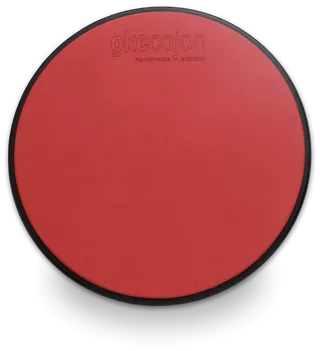 ÖkecajonPRDS-12 Double-Sided₺100View
For a full comparison of sizes, surfaces and weights, see our practice pad buying guide.
How to set up a practice pad: height, angle and posture#
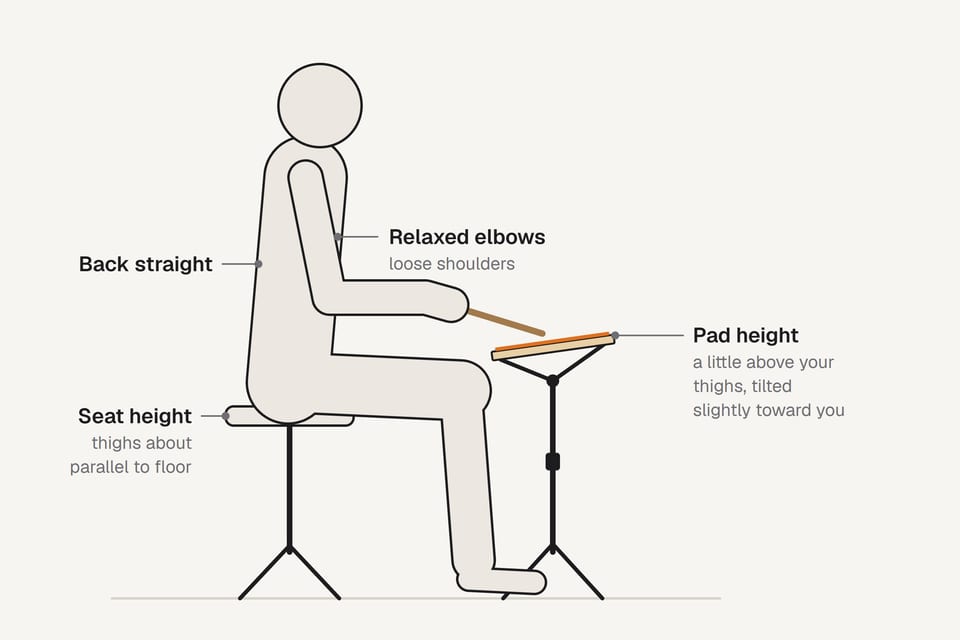
Set the pad at the height your snare would be when you're seated, tilted slightly toward you, with relaxed elbows and loose shoulders. The idea is to practice in the same posture you'll play in; as the Yamaha piece puts it, "how you practice is how you will perform."
Where can you put a practice pad?#
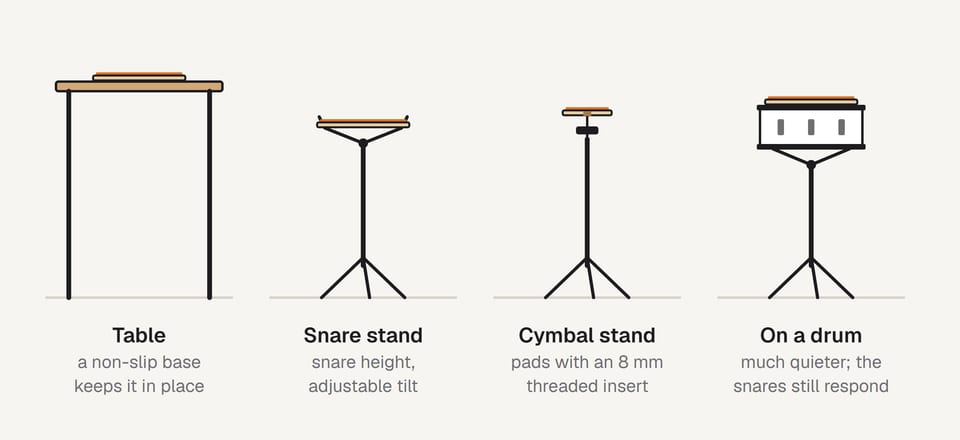
- Table: any flat, sturdy table will do, and the non-slip base keeps the pad in place. If the table is too high for you, your shoulders will creep up; raise your chair or move the pad to a stand.
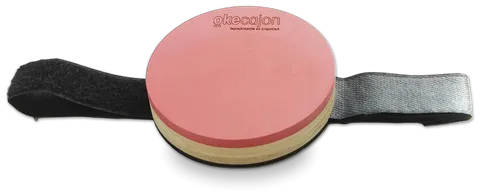
- Knee: a knee pad is a small pad that straps to your thigh. The 4-inch Knee Pad (PRK-4) has a soft rubber surface about 4 in (10 cm) across, a 2-level non-slip base and a hook-and-loop strap, and weighs about 125 g (4.4 oz), which makes it easy to take along for warm-ups on the road or backstage.
- Snare stand: Vic Firth says its 12-inch pads fit most snare stands. A stand puts the pad at snare height, and if yours has a tilt adjustment, you can use it to angle the pad slightly toward you.
- Cymbal stand: pads with an 8 mm threaded insert screw onto a cymbal stand, so you can set one up right next to your kit. That's how the 6-inch Mountable Practice Pad (PRV-6) works; the stand isn't included.
- On a drum: setting a pad on a snare drum's head severely mutes the drum, while your strokes still carry through to its natural snare-side response (Wikipedia).
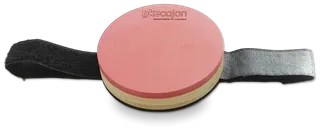 Ökecajon4-inch Knee PadPractice Pad, 4-inch Rubber Knee Pad₺100View
Step-by-step setup#
Here's a setup sequence that works well:
- Adjust your throne or chair so your thighs are roughly parallel to the floor, with your feet flat on the ground.
- Place the pad just in front of your knees, a little above your thighs.
- Tilt the pad slightly toward you.
- Pick up the sticks and let your arms hang naturally: elbows relaxed at your sides, shoulders loose. The stick tips should land near the center of the pad.
- Keep your back straight. If you have to reach forward, move the pad closer.
- Put your metronome, and a mirror if you have one, where you can see them.
How to use a practice pad: your first 10 minutes#
Keep your first sessions short and regular: set a metronome to 60–70 BPM (beats per minute), start with one-handed strokes, then move on to single strokes, double strokes and paradiddles. The simple 10-minute routine below is a good place to start; the goal isn't speed, it's even, relaxed strokes from both hands. In the tables, R is your right hand and L your left.
| Time | Exercise | Sticking | Tempo |
|---|---|---|---|
| 2 minutes | One hand, eighth notes: right first, then left | R R R R, then L L L L | 60 BPM |
| 3 minutes | Single stroke roll | R L R L | 60–70 BPM |
| 3 minutes | Double stroke roll | R R L L | 60–70 BPM |
| 2 minutes | Paradiddle | R L R R L R L L | 60–70 BPM |
Count sixteenth notes as "1 e + a": that's four strokes per metronome click, or two for the one-hand exercise.
| Count | 1 | e | + | a | 2 | e | + | a |
|---|---|---|---|---|---|---|---|---|
| One hand (eighths) | R | · | R | · | R | · | R | · |
| Single stroke | R | L | R | L | R | L | R | L |
| Double stroke | R | R | L | L | R | R | L | L |
| Paradiddle | R | L | R | R | L | R | L | L |
- Single stroke roll: the hands alternate, evenly spaced.
- Double stroke roll: each hand plays two strokes in a row, and both should sound equally clean and even.
- Paradiddle: two single strokes followed by a double stroke, so the lead hand switches with every group.
These definitions follow Wikipedia's rudiment descriptions (Wikipedia). For tempo, follow the PAS approach: play each rudiment open-closed-open, meaning slow to fast and back to slow, or at a steady moderate tempo (PAS). Don't squeeze the sticks; let them rebound, and check that both hands drop the stick from the same height and produce the same sound.
To turn these 10 minutes into a plan with weekly tempo targets, try our 4-week practice pad routine.
How to hold drumsticks: a quick guide#
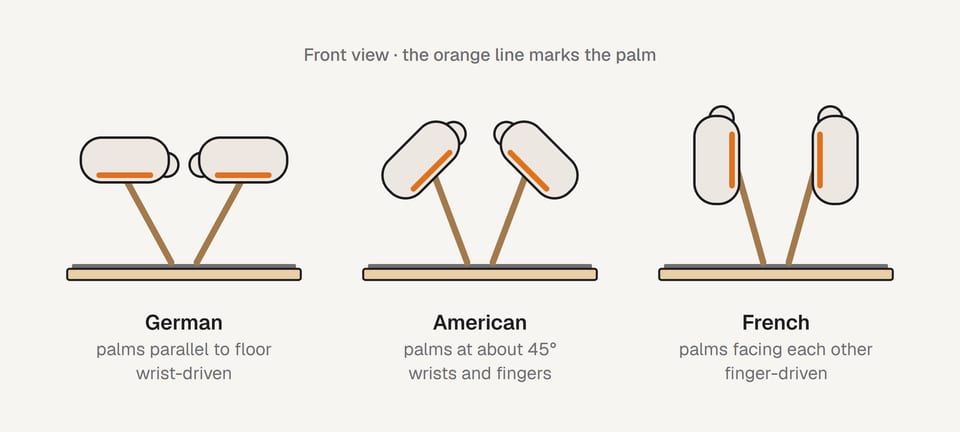
In matched grip, both hands hold the sticks the same way, and the fulcrum, the balance point the stick pivots on, sits between your thumb and your index or middle finger. There are three variations, named for the angle of your palms: German, American and French (Wikipedia).
| Grip | Palms | Driven by | Known for |
|---|---|---|---|
| German | Parallel to the floor | Wrists | Power and a wide dynamic range |
| American | At about 45° | Wrists and fingers together | General-purpose playing |
| French | Facing each other | Fingers | Timpani, fast ride cymbal patterns |
Traditional grip works differently: the right hand holds the stick overhand and the left hand underhand. It comes from the military snare drum, which was carried on a sling and sat at an angle, and it's still common in jazz (Wikipedia).
If you can, choose your grip with a teacher; American grip is described as the general-purpose option. Whichever you pick, hold the sticks loosely enough that they can rebound.
How loud is a practice pad? Practicing in an apartment#
A practice pad is much quieter than a snare drum, but it isn't silent: every stroke makes a short tap. How loud that tap is depends largely on the surface. Vic Firth notes that the harder side of its double-sided pad is slightly louder, and Wikipedia says mesh pads are quieter than rubber or Mylar.
At Ökecajon, the pads designed for low-volume, low-rebound practice are the puff models. The Pop-12 Puff (PRP-12), for example, is a single-sided pad with a polyurethane surface about 11.4 in (29 cm) across on a 12.6 in (32 cm) wooden base, and it weighs 1220 g (2.7 lb). Because the stick bounces back less on a low-rebound surface, your wrists and fingers do more of the work of lifting it.
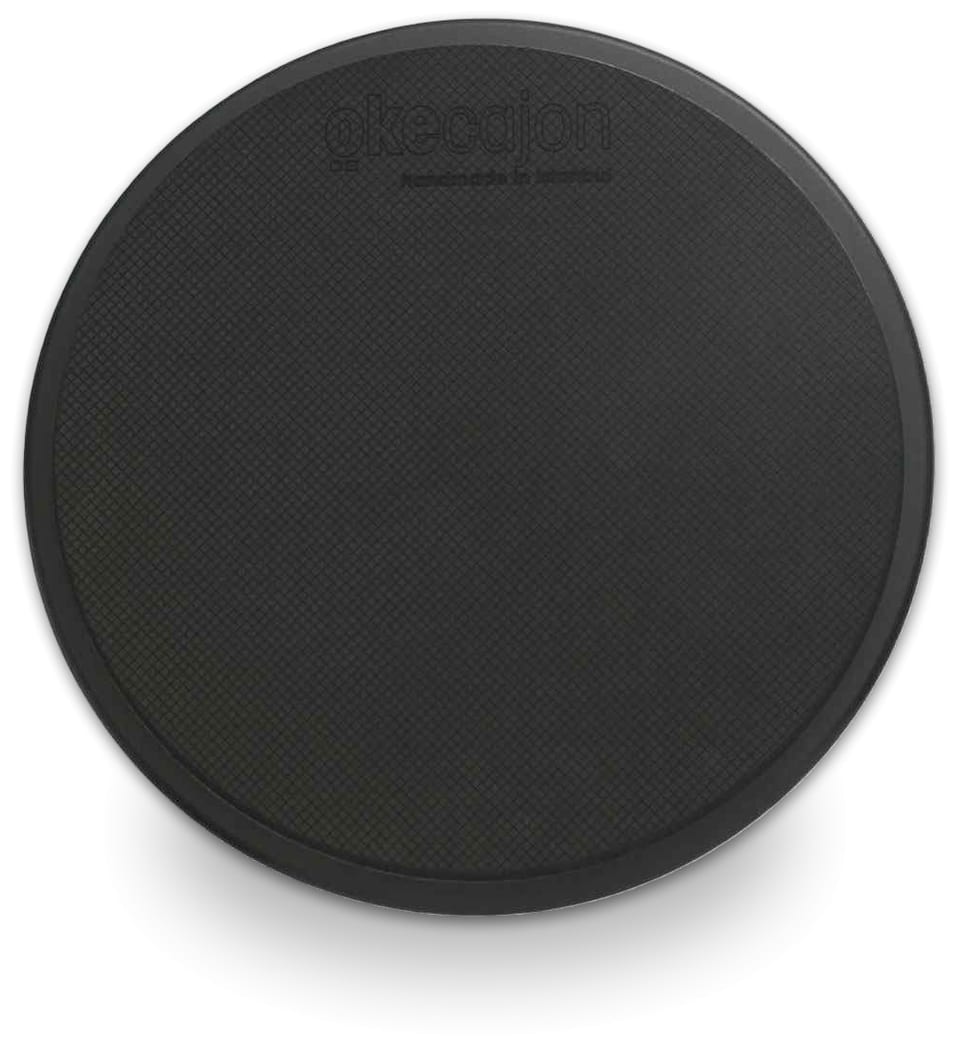
You can quiet down your footwork too. The Kick Pad has a sound-absorbing, non-slip base and lets you practice with your pedal without a drum kit. If you already own a drum, setting a pad on the snare head also cuts the volume noticeably.
How to care for a practice pad#
Caring for a practice pad is simple: keep the surface clean and dry, store the pad away from sunlight and heat, and carry it in a bag. A few general tips:
- Wipe off dust with a dry or slightly damp cloth, and don't put solvents, oils or polish on the surface.
- Keep the pad out of direct sunlight and away from heat sources such as radiators and heaters.
- Store it flat, with nothing heavy on top.
- For the wooden base, the usual rule for wooden percussion applies. LP notes that sudden temperature extremes can damage wood and finishes, and offers a simple rule: if you're comfortable in a room, your instrument is too (LP).
- Use a bag when you travel; Ökecajon's Pad Bag is made of Imperteks fabric.
Which practice pad should you buy?#
If you're getting one pad for home, a 12-inch single-sided rubber pad is a good place to start. For carrying around, go with a 6-inch; for warm-ups, a 4-inch knee pad; and for low volume and low rebound, a puff pad.
| What you need | Model | Why |
|---|---|---|
| One pad for home | PR-12 Single-Sided | About 11.8 in (30 cm) of natural rubber, 3 mm non-slip EVA base |
| Two feels on one pad | PRDS-12 Double-Sided | Natural rubber on one side, puff on the other |
| Something to carry | 6-inch Practice Pad | About 6 in (15 cm) surface, 450 g (1 lb) |
| Warm-ups, travel, backstage | 4-inch Knee Pad | Straps to your thigh, about 125 g (4.4 oz) |
| Low volume and low rebound | Pop-12 Puff | Polyurethane surface, low rebound |
| Mounting on a cymbal stand | 6-inch Mountable Practice Pad | 8 mm brass threaded insert |
| Practicing with a snare sound | Poss-10 Snare Pad | Metal beads inside the wooden body |
| Footwork | Kick Pad | Works with twin pedals, sound-absorbing non-slip base |
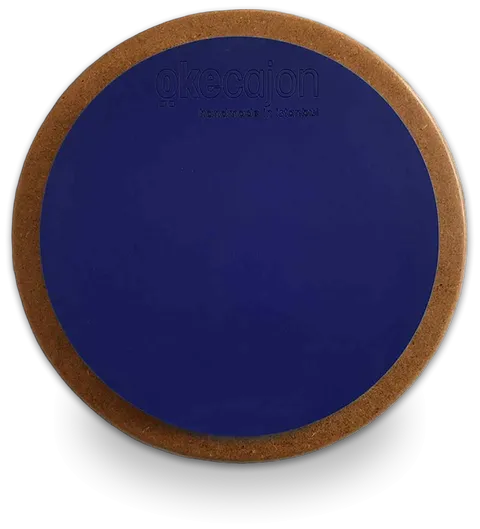
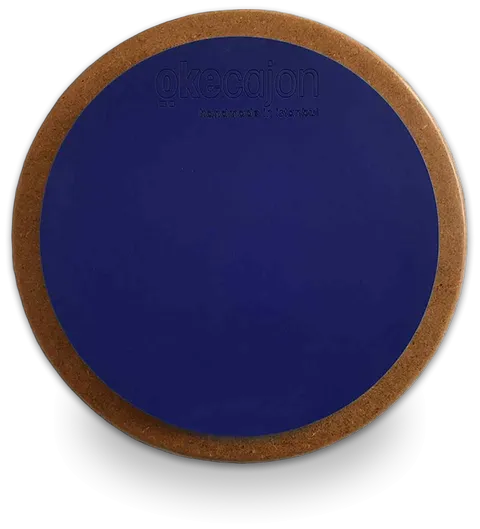
The PR-12 Single-Sided has a soft natural rubber surface designed for a realistic feel, and it comes in blue, red and green. Our practice pad buying guide compares sizes, surfaces and weights in detail, and you'll find every model in the practice pad category.
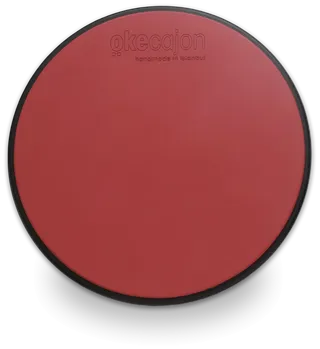 ÖkecajonPR-12 Single-SidedPractice Pad, 12 Inch, Single-Sided, Rubber, Drum Pad₺100View
Frequently asked questions
Is a practice pad the same as a drum pad?
Yes. Drum pad is another common name for a practice pad: a flat, usually rubber-topped pad on a rigid base that drummers play with sticks to practice quietly and warm up. Don't confuse it with the pads on an electronic drum kit, which trigger sounds.
Can you learn drums on just a practice pad?
You can build solid hand technique on a pad, but it isn't enough on its own. Moving around the kit and judging your sound by ear have to be learned on a real drum or kit, and your feet need their own practice. Pair pad work with time on a drum and footwork on a kick pad.
Does practicing on a pad translate to the drum kit?
The hand skills you build on a pad, such as stick control, rudiments and timing, carry over to the drums. But as Paul Winterhalter points out on Yamaha Hub, a pad feels different from a real drum and won't train your ear for your sound. So take the patterns you learn on the pad to a real drum on a regular basis.
Are practice pads quiet?
They're much quieter than a snare drum, but not silent: every stroke makes a short tap. The surface matters too: Vic Firth notes that the harder side of its double-sided pad is slightly louder than the softer side, and Wikipedia says mesh pads are quieter than rubber. At Ökecajon, the pads designed for low-volume, low-rebound practice are the puff models.
What size practice pad should I get?
For a single pad at home, a 12-inch (about 30 cm playing surface) is a good place to start; for carrying in a bag, a 6-inch (about 15 cm) is easier. For warm-ups and travel, there are 4-inch knee pads that strap to your thigh. Choose based on where you'll use the pad most.
Can you use a practice pad on a stand?
Yes. Vic Firth notes that its 12-inch pads fit most snare stands, and pads with an 8 mm threaded insert mount on a cymbal stand. A stand lets you set the pad at snare height, which keeps your posture close to how you sit at the kit, though a sturdy table works too.
Is a practice pad worth it for beginners?
For most beginners, yes. A pad lets you work on hand technique and timing quietly, anywhere and with a metronome, and it's the traditional place to practice rudiments. It won't replace a drum, though, so plan regular time on a real one too.
Sources#
- Practice pad — Wikipedia
- Double-Sided Practice Pads — Vic Firth
- RealFeel Apprentice Drum Pad, 7 inch — D'Addario (Evans)
- Pitfalls of Drumming on a Practice Pad — Yamaha Hub
- Drum rudiment — Wikipedia
- Rudiments — Percussive Arts Society
- Matched grip — Wikipedia
- Traditional grip — Wikipedia
- FAQ — Latin Percussion (LP)
Instruments in this article
Shop Practice Pad →
4 colors
3 colors
5 colors
4 colors
5 colors


More from the Academy
Rhythm Academy →
Practice Pad
Practice Pad Buying Guide: Size, Surface, Rebound and Mounting
What size practice pad should you get? Compare 1- to 12-inch pads, rubber vs. low-rebound polyurethane, snare-sound pads, knee pads and 8 mm mounts.
18 min read
Cajon
What Is a Cajon? Origins, Anatomy, Sounds and Types
A cajon is a box-shaped percussion instrument from Peru that you sit on and play with your hands. See how it's built, how it sounds and its main types.
20 min read
Percussion
Hand Percussion Instruments: Names, Types and Which One to Start With
A visual guide to hand percussion: cajons, shakers, bongos, congas, tambourines and wood blocks, how each makes sound and which is easiest to start with.
18 min read