Hand Percussion Instruments: Names, Types and Which One to Start With
A visual guide to hand percussion: cajons, shakers, bongos, congas, tambourines and wood blocks, how each makes sound and which is easiest to start with.
Ökecajon Workshop18 min read
In this article
- What counts as hand percussion?
- How are percussion instruments classified? Idiophones vs. membranophones
- Hand percussion instruments list: names and how they're played
- Cajon
- Shakers
- Bongos and the bongo cajon
- Congas (quinto, conga, tumba) and the cajonga
- Tambourine and the wooden cajon tambourine
- Wood block
- Castanets and cajon castanets
- Djembe and darbuka (goblet drums)
- Hand percussion comparison chart
- Which hand percussion instrument is easiest to start with?
- How do you expand a cajon setup?
- Safety with small percussion for kids
- Frequently asked questions
- Sources
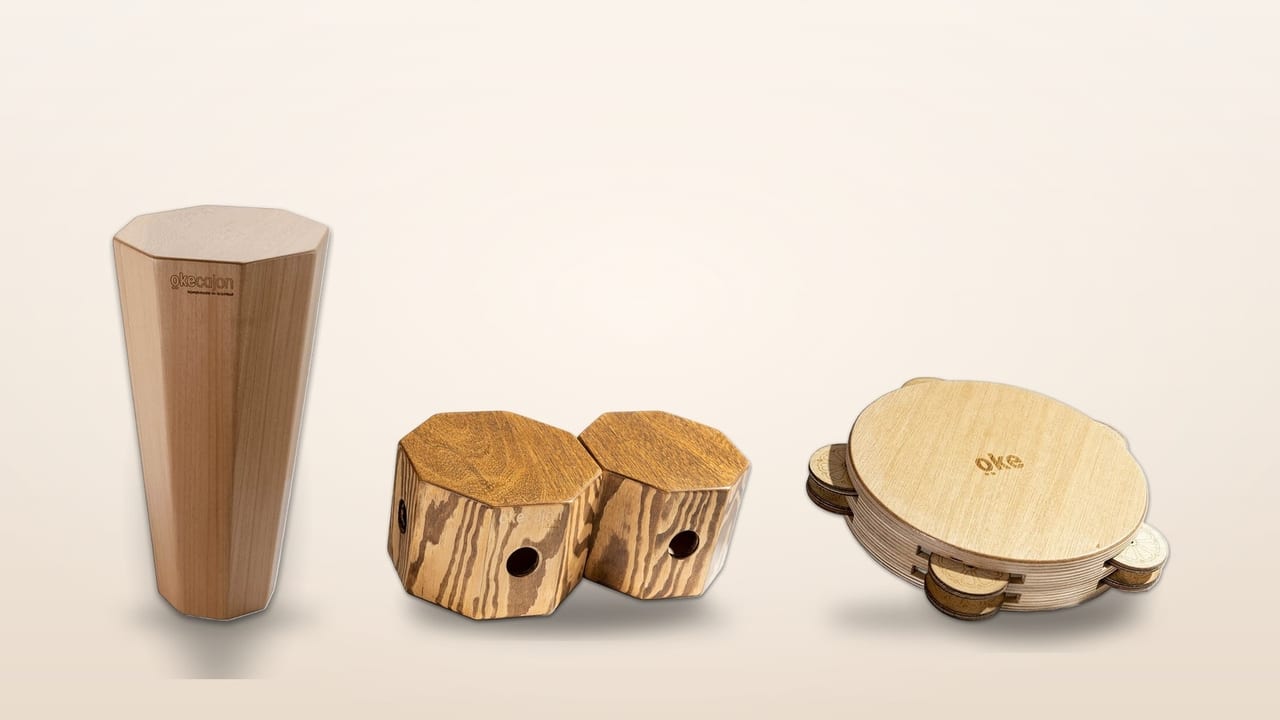
Say "percussion" and most people picture a drum kit, but the hand percussion family is much bigger: the cajon from Peru, bongos and congas from Cuba, the shaker in your palm, castanets, heard in flamenco, and goblet drums like the West African djembe. Where we make a wooden version of an instrument, we show it along the way; most of them are in our percussion collection.
What counts as hand percussion?#
Percussion is the family of instruments you strike, shake or click together to make a sound. Hand percussion is the part of that family you hold in your hand, on your lap or between your knees and play with your hands or a light stick. Someone who plays it is a percussionist.
These are the hand percussion instruments you'll come across most often:
- Cajon: A wooden box from Peru that you sit on and play with your hands.
- Shaker: A rattle filled with grains that you play by shaking it.
- Bongos: Two small joined drums held between the knees.
- Conga: A tall, single-headed drum from Cuba.
- Tambourine: A frame fitted with pairs of metal jingles, with or without a drumhead.
- Wood block: A slotted block of wood struck with a stick.
- Castanets: Two concave shells clicked together in the hand.
- Djembe and darbuka: Goblet-shaped drums, the first from West Africa and the second heard mostly across North Africa, the Middle East and the Balkans.
Among Latin percussion instruments, bongos and congas come from Cuba and the cajon from Peru, and the wood block turns up in Latin music too. The drum kit and orchestral percussion such as timpani and xylophone belong to the same wider family but aren't covered here. If you're a drummer looking for quiet practice at home, start with our guide to what a practice pad is.
How are percussion instruments classified? Idiophones vs. membranophones#
Percussion instruments fall into two main groups depending on where the sound comes from: idiophones, which sound through their own body, and membranophones, which sound through a stretched membrane. The split comes from the Hornbostel–Sachs system, devised by Erich Moritz von Hornbostel and Curt Sachs and first published in 1914; it's the system ethnomusicologists use most widely to classify instruments (Wikipedia). It has five top-level groups: idiophones (1), membranophones (2), chordophones, or strings (3), aerophones, which sound through a vibrating column of air (4), and electrophones (5), which Sachs added in 1940.
- Idiophones: The sound comes from the vibration of the instrument's own body, not from a string, membrane or column of air. Roughly speaking, every percussion instrument that isn't a drum is an idiophone; the xylophone is one too.
- Membranophones: The sound comes from a tightly stretched membrane. All drums belong here.
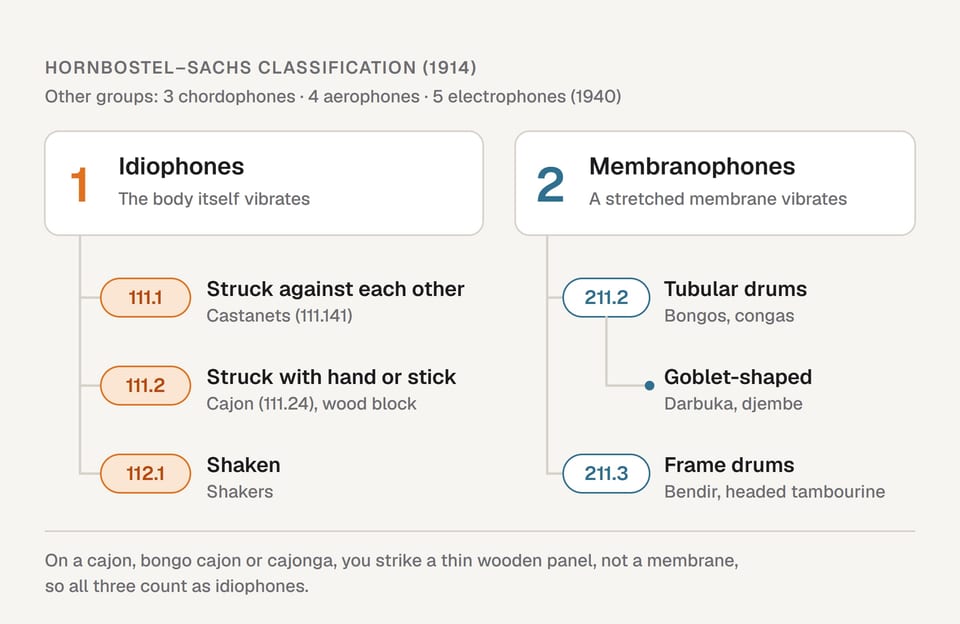
Each group is divided further by how the instrument is set vibrating and by the shape of its body. These are the subgroups that matter for hand percussion:
| Subgroup (code) | How the sound is made | Examples |
|---|---|---|
| Concussion idiophones (111.1) | Two or more matching parts are struck against each other | Castanets (111.141) |
| Percussion idiophones (111.2) | The instrument is struck with a hand, stick or mallet | Cajon (111.24), wood block |
| Shaken idiophones (112.1) | The player shakes it; in a shaker, the grains hit each other and the walls | Shakers |
| Tubular drums (211.2) | A membrane stretched over a tube-shaped body is struck; barrel- and goblet-shaped bodies count too | Bongos, congas, darbuka, djembe |
| Frame drums (211.3) | The body is no deeper than the radius of the membrane | Tambourine with a head, bendir, bodhrán |
The cajon is often called a box drum, but the surface you strike is a thin sheet of wood called the tapa, not a membrane. That makes it an idiophone, number 111.24 in the system (Wikipedia). By the same logic, wooden-faced hybrids like the bongo cajon and the cajonga are idiophones, and so is an all-wood tambourine. The tambourine can actually belong to both groups: its jingles make it a shaken idiophone, and a tambourine with a head is also a frame drum, which makes it a membranophone as well (Wikipedia).
Hand percussion instruments list: names and how they're played#
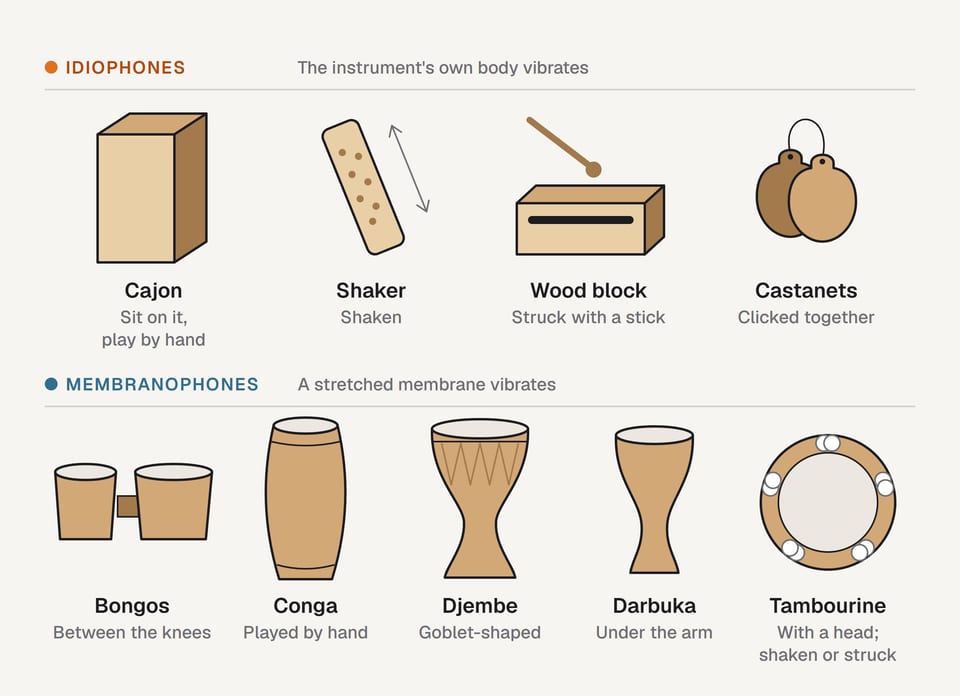
The nine instruments covered here are the cajon, shaker, wood block, castanets, bongos, conga, djembe, darbuka and tambourine. The first four are idiophones and the next four membranophones, while the tambourine is an idiophone through its jingles and, if it has a head, a membranophone too. Where we make a wooden version, you'll find it under each instrument.
Cajon#
The cajon (pronounced "kah-HOHN") is a box-shaped percussion instrument from Peru that you sit on and play with your hands. You sit astride it, tilt it back slightly and strike the front face, called the tapa, between your knees (Wikipedia). The center of the tapa gives a deep bass, and the edges give higher, snare-like sounds (Kopf Percussion).
A traditional Peruvian cajon has nothing inside. The Spanish style that entered flamenco in the late 1970s added guitar strings behind the tapa, and snare wires later took their place (Cajonbox). The wires rest against the inside of the tapa and give the sound a snare-drum buzz.
Our full-size models are in the cajon collection. The Cajon S-Pro (CSP-S), for example, has a 9 mm birch body, a 3 mm birch playing surface and 20×2 snare wires, and measures about 11.4 × 11.8 × 19.7 in (29 × 30 × 50 cm). For the cajon's history, parts and types, read what is a cajon; for posture and your first groove, see how to play cajon. If you want something light to play on your lap or a snare stand, our guide to portable cajons compares the options.
Shakers#
A shaker is an idiophone you play by shaking it: the grains inside hit one another and the inner walls (Wikipedia). In pop and rock it often takes over the steady pattern a drummer would play on the ride cymbal, and you can also strike it to add accents. Shakers range from plastic egg shakers to wooden tubes and boxes.
Our Medium Shaker (WMS-14) is handcrafted from birch, measures about 1.6 × 1.6 × 5.5 in (40 × 40 × 140 mm) and has a lively, warm sound. The same line comes in smaller and larger sizes, and there are cube and mini shakers with metal beads inside, all in the percussion collection. We cover grip, basic rhythms and shaker types in how to play shaker.
Bongos and the bongo cajon#
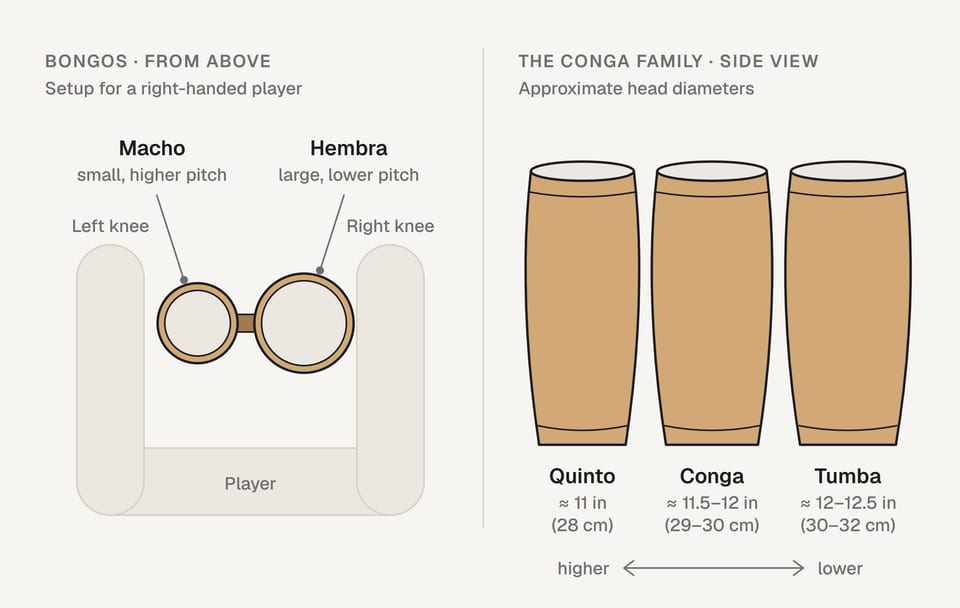
Bongos are an Afro-Cuban instrument: a pair of small, open-bottomed hand drums of different sizes, joined by a wooden bridge. The larger drum is the hembra ("female") and the smaller one the macho ("male") (Wikipedia). Bongos emerged in eastern Cuba at the end of the 19th century and are a mainstay of son cubano and salsa. They're usually held between the legs and played with both hands, although in classical music they're often mounted on a stand and played with sticks or mallets.
Bongos sound higher than congas. According to the same source, right-handed players keep the larger drum, the hembra, on the right. Since a larger head gives a lower pitch, the small macho is the higher drum and the large hembra the lower one (Wikipedia). The basic bongo pattern is the martillo (Spanish for "hammer"), a steady eighth-note ostinato, meaning a figure repeated over and over.
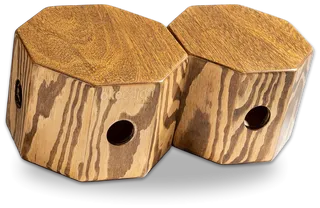
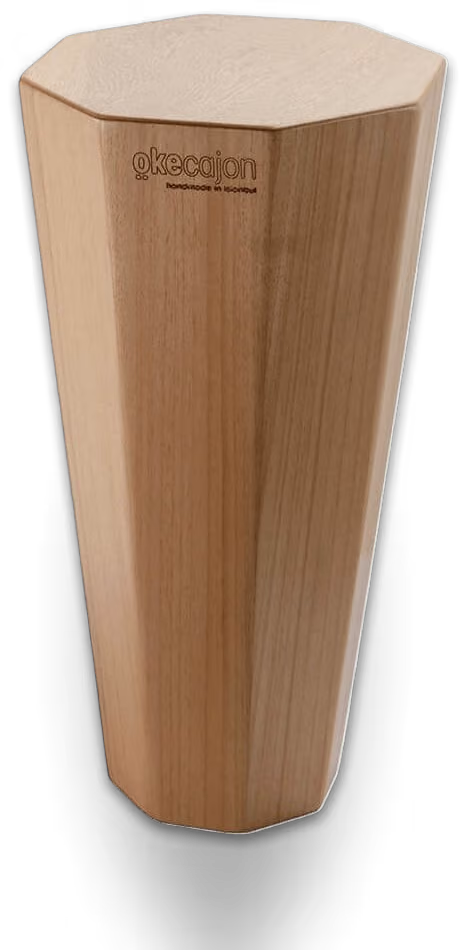
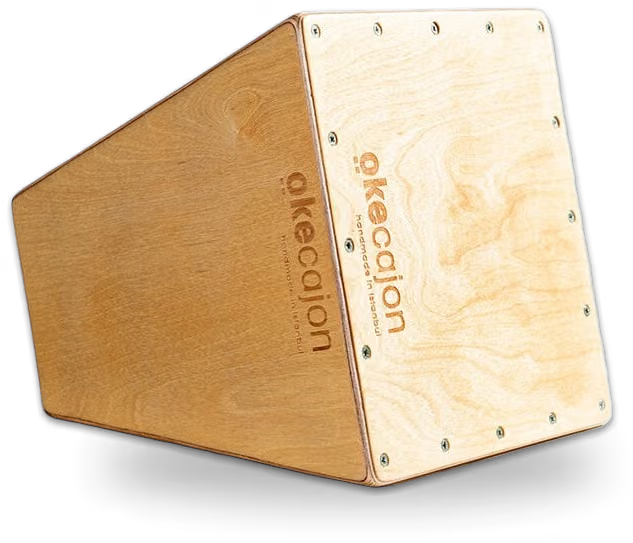
A bongo cajon moves the bongo's high and low playing zones onto a wooden body, and you play it between your legs or on your lap, just like bongos (Meinl). Our Octagonal Bongo Cajon (OCB) is that kind of cajon-bongo combination, and you play it with the same hand and finger techniques as regular bongos. It measures about 8.5 in (21.5 cm) on the hembra side and 7.5 in (19 cm) on the macho side; it has a 12 mm pine body, 3 mm eyong and 3 mm birch playing surfaces, and weighs about 3.7 lb (1,700 g). Unlike regular bongos, it's double-sided: one side sounds natural, and the other buzzes thanks to its snare wires. The Trapezoid Bongo Cajon (BCY), with a 9 mm birch body and snare wires on both sides, weighs about 2.4 lb (1,100 g).
 ÖkecajonOctagonal Bongo CajonBongo Cajon, Octagonal₺100View
Congas (quinto, conga, tumba) and the cajonga#
The conga is a tall, single-headed hand drum that emerged in Cuba in the late 19th or early 20th century (Wikipedia). From largest to smallest, the sizes are the tumba, the conga and the quinto; the middle size shares the family name. The larger the head, the lower the pitch, so of the three the quinto sounds highest and the tumba lowest. Head diameters run roughly 11 in (28 cm) on the quinto, 11.5–12 in (29–30 cm) on the conga and 12–12.5 in (30–32 cm) on the tumba, and the even smaller requinto has a head under 10 in (25 cm).
The conga has four basic strokes: the open tone (tono abierto), the muted tone (ahogado), the bass, played with the full palm, and the slap (seco). The heel-toe motion (manoteo), where the heel of the hand and the fingertips rock onto the head in turn, and the accompaniment pattern called the tumbao are also core parts of conga technique.
So what is a cajonga? It's a cross between a cajon and a conga. Meinl describes its version as an instrument that plays like a conga but sounds like a cajon, and notes that it can be played on its own or as a set of three, by hand or with brushes (Musician's Friend). Our Cajonga stands about 19.3 in (49 cm) tall and 9.8 in (25 cm) across, with an 18 mm ayous body, a 3 mm eyong playing surface and a powerful bass, and weighs about 3.7 lb (1,700 g). You can play it with brushes and mallets, or like a darbuka, and pairing it with an O-Tick widens its range of sounds. Our plywood Conga is in the percussion collection too.
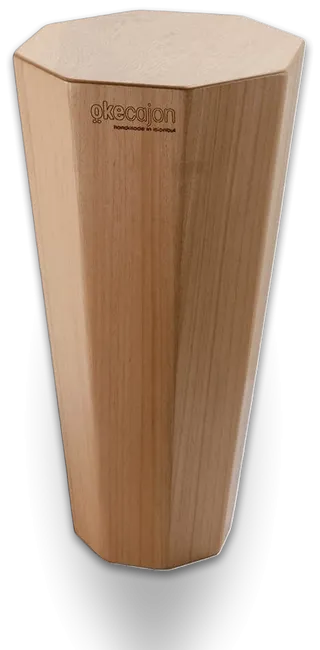 ÖkecajonCajongaCajonga₺100View
Tambourine and the wooden cajon tambourine#
A tambourine is a frame, usually of wood or plastic, fitted with pairs of small metal jingles called zills; it may or may not have a drumhead on one side (Wikipedia). You hold it in your hand and shake it or strike it, and a finger tremolo keeps the jingles ringing.
A tambourine with a head is a frame drum: its head is wider than its shallow body is deep. The Irish bodhrán, the bendir of North Africa and Turkey, and the daf belong to the same family (Wikipedia).
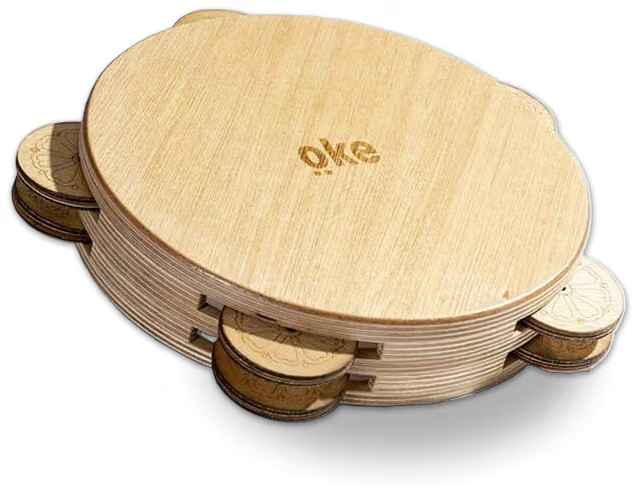
Our Cajon Tambourine (TCT) is all wood, jingles included: a 9 mm birch frame, a 3 mm meranti playing surface, about 9.8 in (25 cm) across, 2 in (5 cm) high and 10.6 oz (300 g). It lets you practice quietly at home and works in the studio and on stage too. With wooden jingles and a wooden playing surface instead of a stretched membrane, it counts as an idiophone.
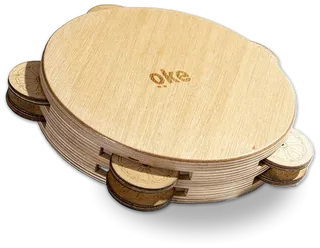 ÖkecajonCajon TambourineCajon Tambourine, Riq, Def, Tambourine₺100View
Wood block#
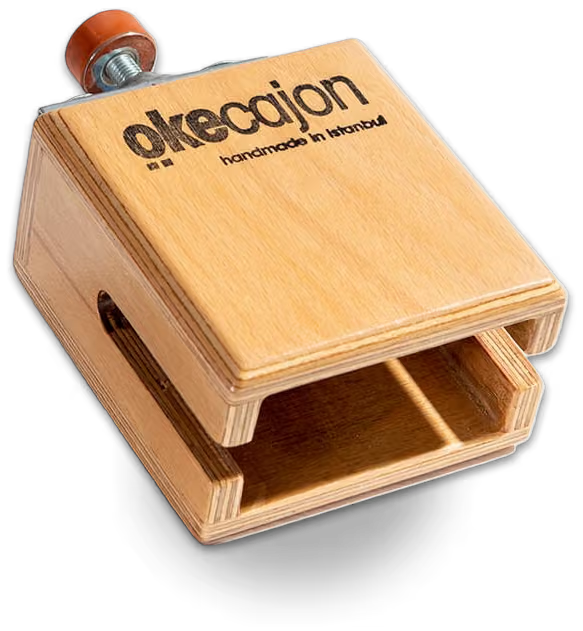
A wood block is a slotted block cut from a single piece of wood, usually teak; it's a type of slit drum (Wikipedia). Struck with sticks it sounds sharp, and with mallets it sounds fuller. You'll hear it in orchestras, jazz, ragtime and Latin music, and the plastic version is called a jam block.
Despite being called a slit drum, it has no membrane, so the wood block is an idiophone. Our Wood Blocks are made of plywood.
Castanets and cajon castanets#
Castanets are a hand-held idiophone: a pair of concave shells joined on one edge by a string (Wikipedia). They produce single clicks for rhythmic accents, or a rattling sound made of a rapid series of clicks. They're traditionally made of hardwood, especially chestnut, though fiberglass has become increasingly popular. The name comes from castanea, the chestnut tree, because the pair looks like the two halves of a chestnut shell.
How do you hold castanets? Players usually use two pairs, one in each hand: the string hooks over the thumb, the shells rest on the palm, and the bent fingers support the other side. Each pair has a slightly different pitch; the lower one usually marks the beat, and the higher one plays variations and rattling figures.
Castanets are best known from Spanish folk dances and flamenco, where both singers and dancers play them. In orchestras they're sometimes fixed to a handle, or mounted on a base as a pair of so-called machine castanets. Their Hornbostel–Sachs number is 111.141, which puts them among the concussion idiophones, instruments whose parts are struck against each other.
O-Tick (TICK-01) is our set of cajon castanets: four wooden pieces in different sizes, from about 0.9 × 2.3 in to 0.9 × 3.5 in (23 × 58 mm to 23 × 88 mm), that attach easily to your instrument with the strips on the back. You can use it on percussion instruments to add new tones to their sound.
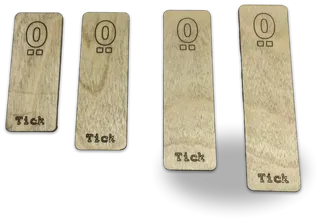 ÖkecajonO-TickO-Tick, Cajon Castanets₺100View
Djembe and darbuka (goblet drums)#
Goblet drums are single-headed membranophones with a goblet-shaped body. The darbuka is most common in the traditional music of North Africa, the Middle East and the Balkans (Wikipedia). It's held under one arm or laid sideways across the lap and played with a light touch of the fingertips and palm. Its three basic sounds are the low "doom" from the center of the head, the high "tak" played near the edge with the fingertips, and the closed "pa," where the hand rests briefly on the head.
There are two main styles. The Egyptian darbuka has a rounded edge around the head, which suits fast rolls, while the Turkish style leaves the edge of the head exposed, which makes finger-snapping techniques possible.
The djembe of West Africa is a goblet-shaped membranophone too, but it's played with quite different strokes from the darbuka's light fingertip technique. We don't make djembes or darbukas, though our Cajonga can also be played like a darbuka.
Hand percussion comparison chart#
This chart puts each instrument's group, playing method, defining feature and our closest counterpart side by side.
| Instrument | Group | How it's played | Defining feature | Ökecajon counterpart |
|---|---|---|---|---|
| Cajon | Idiophone | Sit on it and strike the tapa by hand | Bass in the center, higher sounds at the edges | Cajon S-Pro and other cajons |
| Shaker | Idiophone | Shaken; struck for accents | The sound of the grains inside | Medium Shaker |
| Wood block | Idiophone | Struck with a stick or mallet | Slotted wooden block | Wood Blocks |
| Castanets | Idiophone | Held in the hand, shells clicked together | Two concave shells joined by a string | O-Tick (cajon castanets) |
| Bongos | Membranophone | Between the knees, with both hands | A macho (small) and hembra (large) pair | Octagonal Bongo Cajon (wooden) |
| Conga | Membranophone | By hand: open tone, muted tone, bass, slap | Quinto, conga and tumba sizes | Conga, Cajonga |
| Tambourine | Idiophone; with a head, also a membranophone | Shaken or struck by hand | Metal jingles called zills | Cajon Tambourine (all wood) |
| Djembe | Membranophone | By hand | Goblet-shaped body | — |
| Darbuka | Membranophone | Under the arm or on the lap, fingertips and palm | Goblet-shaped body; doom, tak and pa sounds | — |
Which hand percussion instrument is easiest to start with?#
For most beginners, the easiest hand percussion instruments are the shaker and the cajon. A shaker keeps time with a simple back-and-forth motion. On a cajon, two basic sounds, bass and slap, are enough for a basic pop/rock beat: bass on 1 and 3, slap on 2 and 4 (Rhythm Notes). A 2012 Modern Drummer article on hand drums names djembes, congas and cajons as good bets for beginners, and some of the manufacturer representatives it interviewed single out the cajon as easy to play even without musical training.
The slap is the high, crisp sound near the top edge of the tapa: the lower part of your palm lands on the edge and your relaxed fingers snap onto the surface (Thomann). The chart below shows the basic cajon beat with an eighth-note shaker part on top. B is bass, S is slap and a dot means rest; on the shaker line, Fw is a forward stroke and Bk a back stroke.
| Count | 1 | + | 2 | + | 3 | + | 4 | + |
|---|---|---|---|---|---|---|---|---|
| Cajon | B | . | S | . | B | . | S | . |
| Shaker | Fw | Bk | Fw | Bk | Fw | Bk | Fw | Bk |
Kopf Percussion suggests starting the cajon at around 72–78 BPM (beats per minute) (Kopf Percussion). A practical order to follow:
- Set a metronome to 72 BPM and play the shaker: forward on every beat, back on every "and" (+).
- Practice the cajon's bass and slap separately, then play the beat above.
- Put the two lines together: have a friend play shaker while you play cajon, or play along with a recording of yourself.
- Once the groove feels steady, add a second color: a tambourine, an O-Tick or a Sizzle strapped to your leg.
- Move on to drums like bongos and congas after that; getting the conga's four basic strokes under your hands, for example, takes time.
For grooves in other styles, see cajon rhythms.
How do you expand a cajon setup?#
To turn a cajon into a small kit, add sounds you can reach with your heel, your leg, your lap or the instrument itself: the heel-played Side Kick, the Sizzle leg shaker, the small Jazzgır lap cajon and the O-Tick castanets fixed to the instrument. All four are handcrafted.
- Side Kick (SK): A heel tap and jingle attachment for the cajon. The sound you get with your heel is similar to a hi-hat; it mounts on either side of the cajon and its height is adjustable. The heel piece and the 13.8 in (35 cm) jingle attachment separate with hook-and-loop fasteners, and you can use them in other ways too. It's made from 4, 9 and 15 mm birch plywood, and the main body measures about 11 × 7.9 × 2 in (28 × 20 × 5 cm).
- Sizzle (SZL-01): A wooden piece with metal beads inside for a snare sound, fastened to your thigh with a hook-and-loop strap. It has a sizzling sound; use it on your leg or in your hand while you play cajon, and play it with your hands or brushes. It measures about 8.7 × 4.3 × 0.3 in (220 × 110 × 8 mm).
- Jazzgır (JZG): A small cajon with a wooden lap stand that fastens with hook and loop: 9 mm birch body, 3 mm birch playing surface, about 5.5 × 6.3 × 1.6 in (14 × 16 × 4 cm) and 13.8 oz (390 g). Play it with your hands or brushes.
- O-Tick: The four-piece wooden castanet set covered above; it attaches to the instrument with the strips on the back.
Safety with small percussion for kids#
Some percussion instruments are small enough for young children to put in their mouths, so don't leave them unattended around little ones. Our Mini Shaker (SM-20), for example, is about 0.7 in (18 mm) on each side and has metal beads inside its wooden body. Take the same care with shakers designed as keychains.
If you're looking for a cajon made for young percussionists, the option in our catalog is the Minish Cajon (MSH): about 8.7 × 9.1 × 12.6 in (22 × 23 × 32 cm), with a 9 mm birch body, a 3 mm birch playing surface and 20×1 snare wires.
Frequently asked questions
What are the main types of hand percussion instruments?
The best-known hand percussion instruments are the cajon, shaker, bongos, conga, tambourine, wood block, castanets, djembe and darbuka. The cajon, shaker, wood block and castanets are idiophones, which sound through their own body, while bongos, congas, the djembe and the darbuka are membranophones, which sound through a stretched head. A tambourine is an idiophone through its jingles, and one with a head is a membranophone as well.
What is the difference between an idiophone and a membranophone?
An idiophone makes its sound through the vibration of its own body rather than a string, membrane or column of air; the cajon, shaker, wood block and castanets are examples. A membranophone sounds through a tightly stretched membrane, a group that covers every kind of drum, from bongos and congas to the djembe. Both terms come from the Hornbostel–Sachs system, first published in 1914.
What is the easiest percussion instrument to learn?
For most beginners it's the shaker or the cajon. Rocking a shaker back and forth with a metronome is all it takes to keep time, and on a cajon, bass and slap alone give you a basic pop/rock beat. The conga has more to learn, with four basic strokes.
What is the difference between bongos and congas?
Bongos are a pair of small drums, the macho and the hembra, joined by a wooden bridge and held between the knees. A conga is a tall, single-headed drum with a head of roughly 11 to 12.5 inches (28–32 cm), made in three main sizes: quinto, conga and tumba. Bongos sound higher than congas.
What is a tumba drum?
The tumba is the largest and lowest-pitched drum in the conga family, with a head of about 12 to 12.5 inches (30–32 cm). The middle size is called the conga and the smaller one the quinto.
Is a cajon a percussion instrument?
Yes. The cajon is a Peruvian percussion instrument: a wooden box you sit on and strike with your hands. Since you strike a thin wooden panel rather than a membrane, it's classified as an idiophone (Hornbostel–Sachs 111.24), not a drum.
Are castanets a percussion instrument?
Yes. Castanets are an idiophone: two concave shells joined by a string that you click together in your hand (Hornbostel–Sachs 111.141). Players usually hold one pair in each hand with the string looped over the thumb, and the instrument is closely tied to Spanish folk dance and flamenco.
Instruments in this article
Shop Percussion →


More from the Academy
Rhythm Academy →
Cajon
What Is a Cajon? Origins, Anatomy, Sounds and Types
A cajon is a box-shaped percussion instrument from Peru that you sit on and play with your hands. See how it's built, how it sounds and its main types.
20 min read
Practice Pad
What Is a Practice Pad? What It's For and How to Use One
A practice pad is a quiet surface drummers use to build stick control and warm up. Learn what it does, how to set it up and use it, and what it can't do.
16 min read
Cajon
How to Play Cajon: Posture, Basic Strokes and Your First Groove
Learn cajon step by step: how to sit, where to hit for bass and slap, tones and ghost notes, your first 4/4 groove and a 30-day practice plan.
17 min read